
Padel vs Tennis: Key Differences for US Players (2026)

Padel vs Tennis: Key Differences for US Players (2026)
Court, serve, scoring, equipment, learning curve and cost, side by side
Padel is a doubles game played on an enclosed court a little smaller than a tennis court, with a solid stringless racket, an underhand serve and glass walls that stay in play. Tennis is bigger, faster to punish mistakes and far easier to find a court for in the US. If you are choosing between them, the short version: padel is quicker to enjoy and always needs four people, tennis rewards years of practice and works with two.
Padel vs tennis at a glance
| Padel | Tennis | |
|---|---|---|
| Court | 10 m wide by 20 m long, fully enclosed | 78 ft (23.77 m) by 36 ft (10.97 m) for doubles, open |
| Walls | Glass or solid walls plus mesh, in play | None |
| Players | Doubles | Singles or doubles |
| Serve | Bounce first, hit at or below waist level | Toss and hit before it lands, usually overhead |
| Scoring | 15-30-40, then advantage, Star Point or golden point | 15-30-40 with advantage, or No-Ad |
| Racket | Solid, perforated, max 45.5 cm long | Strung, max 29 in (74 cm) long |
| Ball weight | 56.0 to 59.4 grams | 56.0 to 59.4 grams |
The rest of this post takes each row in turn, with the rulebook wording behind it.
The court: size, walls and surface
The FIP rules define the court as "a rectangle 10 meters wide by 20 meters long". Under the ITF rules, as Wikipedia's tennis court entry sets them out, "The court is 78 ft (23.77 m) long" and its width is "36 ft (10.97 m) for doubles matches". So a padel court is a few metres shorter and about a metre narrower than a doubles tennis court, and four players share it.
The bigger difference is the box. A padel court "must be completely enclosed", and each end is "A total height of 4 meters the first 3 m of which is wall", topped with metal mesh. Tennis has no walls at all: a ball that passes the lines is out. That one change explains most of what feels different about padel. Rallies last longer, because a ball that gets past you can still be played after it rebounds off the glass.
The net is close in height. Padel's is "0.88 high at the center, rising to 0.92 meters at the ends". A tennis net is "3 ft (0.914 m) high in the center". Our padel court dimensions guide covers service lines, ceiling height and surfaces in full.
Rules and scoring: the serve, the walls and the deciding point
The serve. In tennis, players "begin a serve by tossing the ball into the air and hitting it" (Wikipedia), which is why the big overhead serve dominates the men's game. In padel, "The server must bounce the ball on the ground to serve", and the ball "must be at or below the waist level at the moment of hitting it". The rulebook sets no fixed serve height in centimetres, whatever you may have read elsewhere. The serve in padel starts the point; it rarely wins it. For the faults that trip up new players, see illegal padel serves.
The walls. Rule 14 of the FIP rules ("Correct Return") says the return is correct if "The ball bounces in the opponent’s court and then hits the metallic fence or one of the walls." You can also play the ball off your own glass, since a return counts if it "hits the wall in the players own court first and it then bounces into the opponent's court." What you cannot do is hit the opponents' walls or fence before the ball bounces on their side.
The score. Both sports count 15, 30, 40, game, and both play sets to six games with a tie-break. The difference is at deuce. Since January 2026 the FIP rulebook offers three options: "Option 1: Advantage", "Option 2: Star Point" and "Option 3: Golden Point". Star Point allows two advantages, then one deciding point. Tennis plays advantage by default. Under its "no-ad" alternative, "if the game is tied at deuce, the next player to win a point wins the game" (Wikipedia). Clubs choose their format, so ask before your first match. Our golden point vs advantage guide and how to keep score in padel cover the details.
Equipment: solid racket vs strung racket
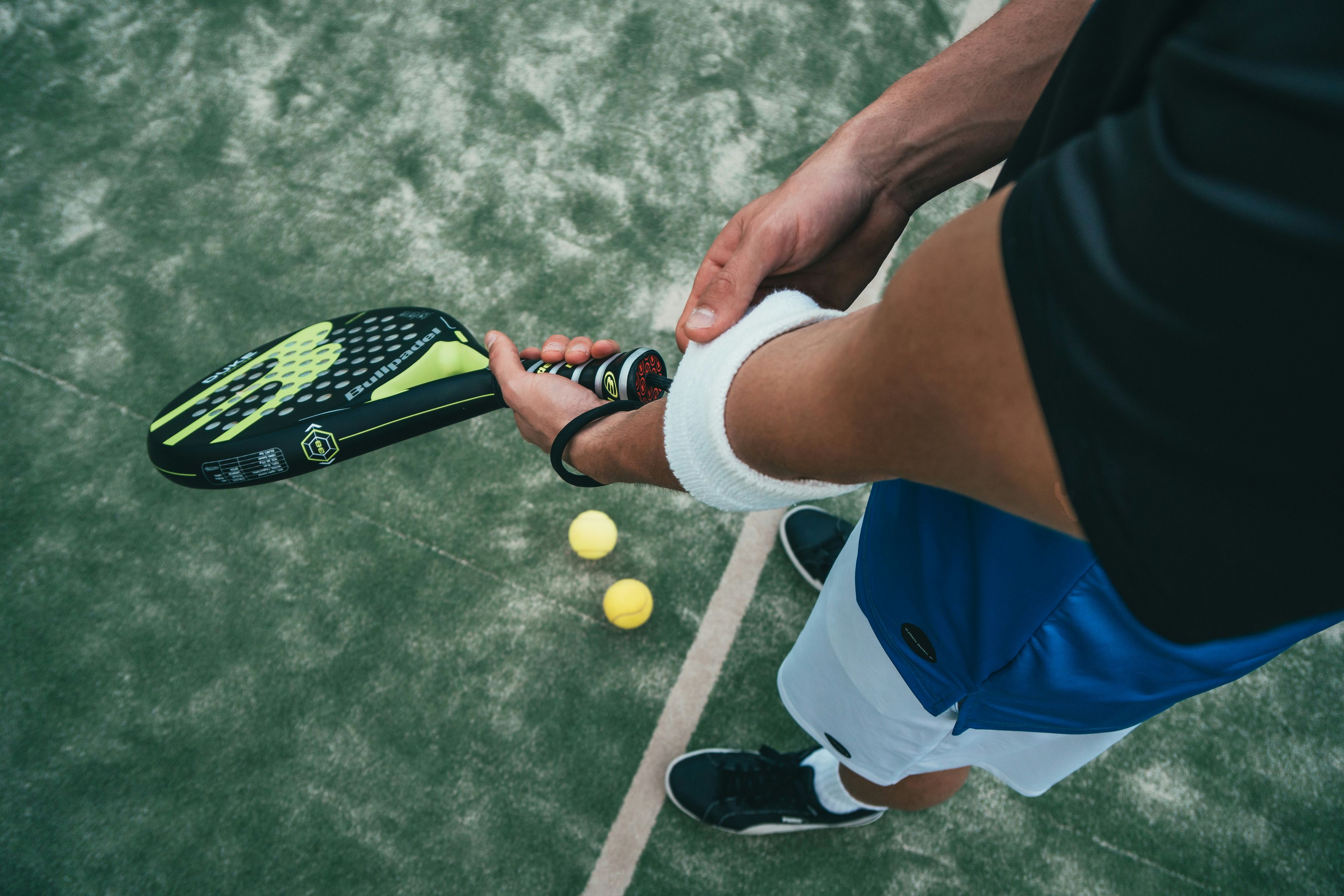
A padel racket has no strings. Its face is perforated with holes "between 9 and 13 mm in the center area", and "The total length of the padel racket, head plus handle, may not exceed 45.5 centimeters." A tennis racket frame has been limited to 29 inches (74 cm) since 1997, and its hitting area is "composed of the strings" (Wikipedia). The short, solid padel racket is easier to control at the net, and there is no restringing bill.
The balls are closer than most people assume. Both rulebooks set the weight at the same range: FIP gives "weight between 56.0 y 59.4 grams" and tennis balls under ITF rules "must have masses in the range 56.0–59.4 g" (Wikipedia). The real difference is pressure. FIP requires "an internal pressure of between 4.6 Kg and 5.2 Kg per 2.54 square cm", which is why padel balls feel slower and why players replace them often. Our post on how long padel balls last has the detail.
If you already own good tennis shoes, read padel shoes vs tennis shoes before buying a second pair. Tennis players shopping for a first padel racket should start with the best padel rackets for tennis players.
Physical demands and injury risk
We could not find a federation or peer-reviewed source comparing injury rates between the two sports that we would stand behind, so this section is general guidance, not statistics.
Padel covers less ground. The court is smaller, you share it with a partner, and the walls give you a second chance on balls that would be winners in tennis. That makes it gentler on beginners' fitness and on older players. The movements are short and repetitive: lateral shuffles, quick stops, lots of low balls and overheads. Calves, knees and the hitting shoulder take the load. Tennis asks for longer sprints and a full overhead serve on every point you serve, which is where many tennis shoulder complaints start.
Players with tennis elbow should note that a solid padel racket transmits vibration differently from a strung frame, and soft-foam models are the usual choice. See padel rackets for tennis elbow.
Learning curve: which is easier to start?
Padel is easier to start. The underhand serve goes in, the short racket is forgiving, and the walls keep the ball alive, so a group of four beginners can have real rallies in their first hour. Tennis takes longer before a match feels like a match: a beginner spends much of the first months serving faults and collecting balls from the back fence.
The ceiling is a different story. Padel's hard part is reading the ball off the glass and learning when to stay back, and that takes as long to master as a reliable tennis backhand. Tennis players have a head start on hand-eye skills and net play but need to unlearn the instinct to swing hard at everything. If that is you, our tennis to padel guide covers the technique changes.
Cost and court access in the US
This is where tennis wins outright. Most US towns have public tennis courts, and many are free to walk on. Padel in the US is mostly private: our directory lists 355 open US padel clubs with 1,314 courts between them, and most charge by the hour. See public padel courts in the US for the exceptions.
Because padel is always four players, the per-person price is lower than the court rate suggests. At CityView Racquet Club in Long Island City, Queens, padel court time for non-members is "$55 off peak / $70 peak" per hour (its FAQ, read 19 November 2026). Split four ways, that is a quarter of the court rate each. Members pay "$30 off peak / $40 peak". For what memberships, lessons and gear add up to across the country, read how much padel costs in the US and our padel club membership guide.
Which should you play?
Pick padel if you want a social game where you are rallying in the first session, you have three friends to play with, and there is a club within reasonable driving distance. Pick tennis if you want to play singles, prefer free public courts, or like a sport where the serve and raw pace decide matches.
Plenty of people do both. The skills transfer better from tennis to padel than the other way round, and the tennis players who struggle at first are usually the ones who keep hitting the ball too hard into the back glass. Search the club directory to see whether there is a padel court near you, and compare padel with other racket sports in our guides to padel vs pickleball, padel vs squash and padel vs platform tennis.
Frequently Asked Questions
Continue Reading
Padel in Mexico: The Spanish Words You'll Hear on Court
Padel in Mexico: The Spanish Words You'll Hear on Court
Mexican clubs say cancha, not pista, and book open matches as retas. This phrasebook covers the booking words, the Spanish score calls from iguales to punto de oro, the shot names Mexican clubs name themselves after, and why the racket is a pala.
Padel Levels Explained: How to Rate Yourself (0 to 7)
Padel Levels Explained: How to Rate Yourself (0 to 7)
Playtomic levels run from 0 to 7, and your number decides which open matches you can join. Here's what each level looks like on court, a 10-question self-check, and the rules that move your level after a match.
Padel Strategy for Intermediate Players: Zones, Lobs, Net
Padel Strategy for Intermediate Players: Zones, Lobs, Net
Intermediate padel points are won by shot choice, not power. This guide covers what to hit from each zone of the court, where to aim lobs, how to keep the net once you win it, and the pair patterns that stop points slipping through the middle.