
Can You Wear Tennis Shoes for Padel? A 2026 US Guide

Can You Wear Tennis Shoes for Padel? A 2026 US Guide
Clay-court models are near-cousins. Hard-court models skate. Running shoes are the actual danger.
Yes — you can play padel in tennis shoes, and most US clubs will happily let you on court in them. But the useful answer is narrower than that: which tennis shoes. Clay-court models are close to the real thing. All-court models work and wear out fast. Hard-court models are the ones that skate on you.
The Short Answer
Tennis shoes are a legitimate way to start playing padel. They're court shoes — low to the ground, laterally reinforced, stiff enough to survive side-to-side load. That's 80% of what a padel shoe does.
The label on the box matters far less than the outsole underneath it. A clay-court tennis shoe and a padel shoe are near-cousins. A hard-court tennis shoe and a padel shoe are not, and the gap shows up on your first hard stop.
US clubs largely agree. Padel Haus — which runs courts in Brooklyn, Nashville, Atlanta, Dallas and Denver — puts it plainly in its FAQ: "While we recommend padel shoes, any sneaker with a low drop and decent tread will do." That's the mainstream US position.
So the question isn't whether you're allowed. It's how much you're giving up, and how long that trade stays sensible.
What Actually Differs
Outsole Pattern: Herringbone vs Hard-Court Tread
Almost every padel court in the US is artificial turf with silica sand brushed into the fibers. You're not playing on acrylic — you're playing on a thin, shifting layer of sand sitting on plastic grass.
Padel outsoles answer that with a full herringbone (sometimes called fishbone or espiga) pattern: continuous V-shaped ribs running across the sole. The ribs bite through the sand to the backing, then release cleanly when you unweight. Clay-court tennis shoes use the same pattern for the same reason — clay behaves like sand.
Hard-court outsoles are built on the opposite premise: broad, flat contact zones, because a hard court supplies its own grip and the design problem is durability, not penetration. Put that flat rubber on sand and it rides on top of the infill instead of cutting through it.
Where the Stability Sits
Tennis is played with long approach runs and wide, extended slides, so tennis shoes concentrate reinforcement at the heel and the outer lateral wall.
Padel happens in a 20x10-meter box. Movement is shorter, more frequent, and pivots around the midfoot — you're constantly rotating to face a back wall, then rotating back. Padel shoes bias their torsional stiffness and support cage toward the midfoot for exactly that reason.
A tennis shoe won't fail you here. It's just tuned for a movement pattern you're no longer doing.
Grip Versus Glide on Sand
The thing nobody tells beginners: you don't want maximum grip on a padel court. You want controlled release.
Padel involves short, deliberate slides — into a low volley, out of a corner, stopping under a lob. A shoe that grips absolutely stops your foot while your body keeps traveling, which loads the knee and ankle. Herringbone is calibrated to grip on the push and let go on the stop.
Hard-court tennis shoes get this wrong in both directions at once: too little bite going in, then too abrupt a catch when the tread finally finds the backing.
Cushioning and the Back-Wall Reset
Padel's signature movement is backing up to let a ball come off the glass, then pushing forward again — dozens of times a match, landing on the heel each time. Tennis shoes handle this well, because heel-first landings are what they're built for. It's the one area where a tennis shoe isn't a compromise at all.
Which Tennis Shoes Work as a Stopgap
Clay-Court Tennis Shoes — The Closest Match
If you own clay-court tennis shoes, put them on and go play. The full herringbone outsole speaks the same design language as a padel shoe, and the compound is already built to shed loose particles rather than pack them.
What you're missing is padel's midfoot support cage and the medial toe-drag protection that padel shoes add where you scuff dragging into a low volley — so you'll wear through the inside forefoot faster. For most recreational players this is a genuinely fine long-term answer, not just a stopgap.
All-Court Tennis Shoes — Usable, Wears Fast
All-court models use a partial herringbone with flattened sections for durability. They grip acceptably on turf and won't get you hurt.
The catch is lifespan. Their harder rubber is tuned for abrasive hard courts, and the shallow tread depth means you lose the pattern quickly — expect noticeably less grip well before the shoe looks worn out.
Hard-Court Tennis Shoes — The Worst Offender
This is the pair most American players actually own, and it performs worst. You'll feel it as a specific sensation: pushing off to cover a cross-court ball and feeling the foot travel a few centimeters before it catches. Survivable for a first session. Not something to build a habit on.
What You Should Never Wear
Running shoes and cross-trainers are the real line, and this is a safety argument rather than a snobbery one.
A running shoe is engineered for one plane of motion. Its tall, soft, narrow midsole stack is designed to compress under a forward heel strike and roll you toward the toe. Load that stack sideways — which is what every padel push-off does — and the foam deforms laterally with your ankle on top of it. That's how ankles roll, and the higher the drop and softer the foam, the worse the geometry.
Cross-trainers are more stable but bring a different problem: aggressive, blocky lugs that catch in turf fibers instead of releasing, dragging infill out of position.
If court shoes aren't an option today, a flat-soled tennis shoe beats any running shoe you own. Our guide to what to wear for padel covers the rest of the kit.
Will Tennis Shoes Damage the Court?
Mostly no — but the reason is worth understanding, because the "non-marking shoes" rule posted at US racquet clubs was written for a different surface.
Marking is a hard-court and gym-floor problem: dark, hard rubber scuffing acrylic or wood. On artificial turf with sand infill there's nothing to scuff. Any tennis shoe is non-marking in the sense that matters.
The real concern on a padel court is mechanical — deep or sharp lugs pulling at turf fibers and displacing infill, which degrades both the bounce and the surface's lifespan. That's why clubs care about trail runners and cross-trainers and generally shrug at tennis shoes. The exception: if your courts share a building with hard courts, house rules may apply the stricter standard throughout.
When It's Worth Buying Dedicated Padel Shoes
The honest threshold is frequency, not skill level.
Playing once or twice a month? Your tennis shoes are fine. Playing weekly? Buy padel shoes — not because you'll suddenly move better, but because you'll stop destroying tennis shoes at an absurd rate. Padel turf is abrasive, and a hard-court shoe burns through its tread far faster on it than on the surface it was built for.
For reference, padel shoes typically last 60–100 hours of play — roughly six to twelve months at two sessions a week. When you can see midsole through the outsole, or the herringbone ribs have flattened, the grip is already gone.
The other trigger is the corner. Once you're genuinely playing the walls — reading a ball off the back glass, sliding into a corner and recovering — midfoot support and controlled release start to matter. Below that level, they mostly don't.
Switching over from tennis generally? Our tennis-to-padel guide and our best padel rackets for tennis players cover the rest of the transition.
US Buying Picks
Three shoes in stock on US storefronts, in USD and US sizing, verified September 2026. For the full field see our complete padel shoe buying guide, or narrow by court surface, men's and women's fit, wide feet, or budget.
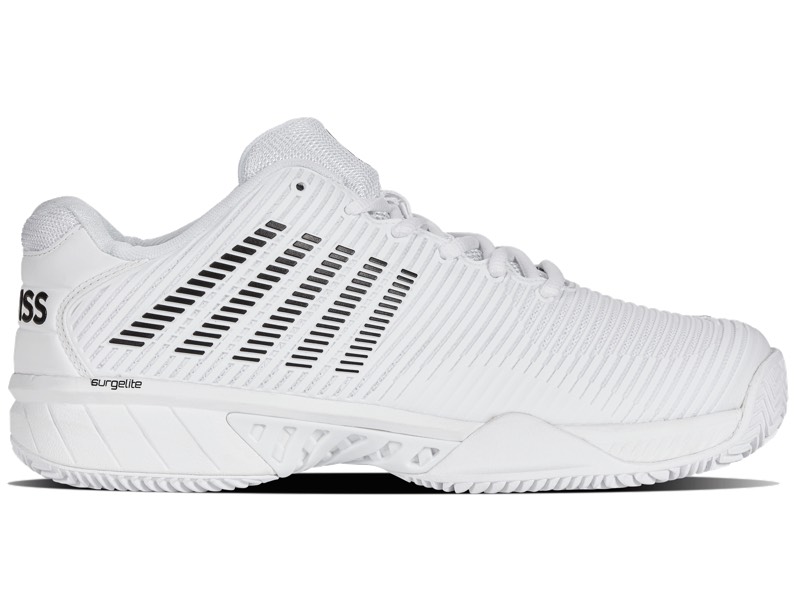
K-Swiss Hypercourt Express 2 Clay
If the argument above convinced you that clay-court tennis shoes are the right stopgap, this is the one to buy. K-Swiss sells it as a tennis shoe, but the clay outsole is a full herringbone that behaves correctly on sand-infilled turf.
The build is unglamorous and durable: synthetic leather upper, DuraWrap Flex wrapping the forefoot where toe-drag chews through cheaper shoes, and a Surgelite-updated CMEVA midsole firm enough to feel the court. K-Swiss runs a generous last, so it's worth a look if padel-specific shoes pinch you. Currently 30% off — the cheapest sensible way onto a padel court.
Weight: ~13 oz (size 10.5) | Outsole: Full herringbone, clay | Midsole: Surgelite CMEVA | Fit: Roomy
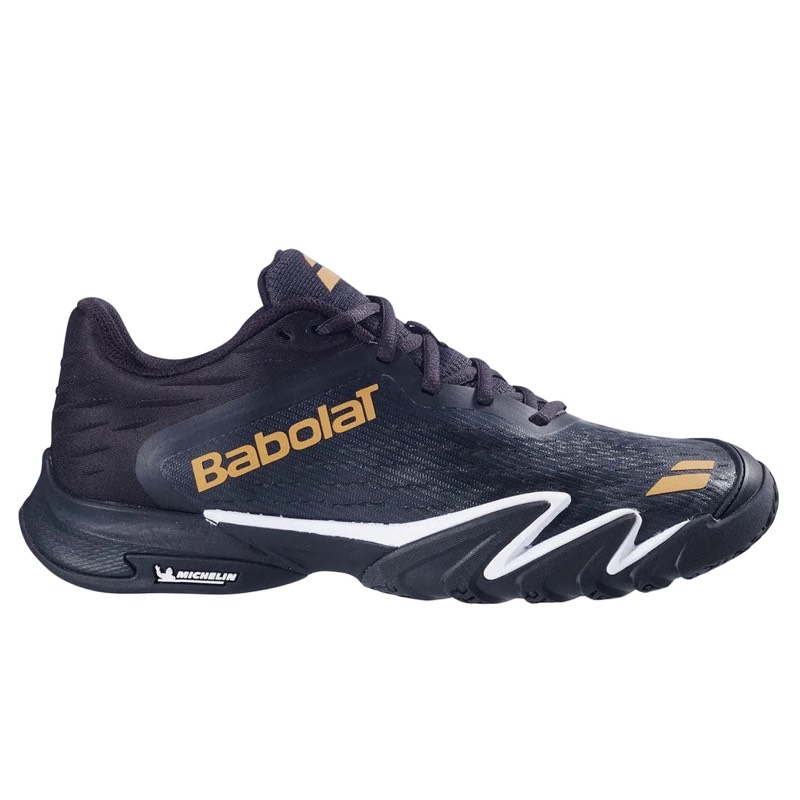
Babolat Premura 3
The clearest illustration of what a padel-specific outsole buys you. Babolat developed this one with Michelin, and the 360° Flex grooves let the sole bend with the foot through a slide instead of fighting it — the controlled release a hard-court tennis shoe can't produce.
Above the sole it's competition kit: a woven Matryx MICRO upper, HumanFab forefoot "teeth" for rotational stability, and 3D heel elements for the repeated back-wall landing. At 30% off it undercuts most entry-level padel shoes while being a genuinely advanced one — but the size run is thin, so check before you commit.
Weight: 12.9 oz (size 10.5) | Outsole: Michelin padel rubber, 360° Flex | Fit: Slightly narrow, medium arch | Surface: Padel turf
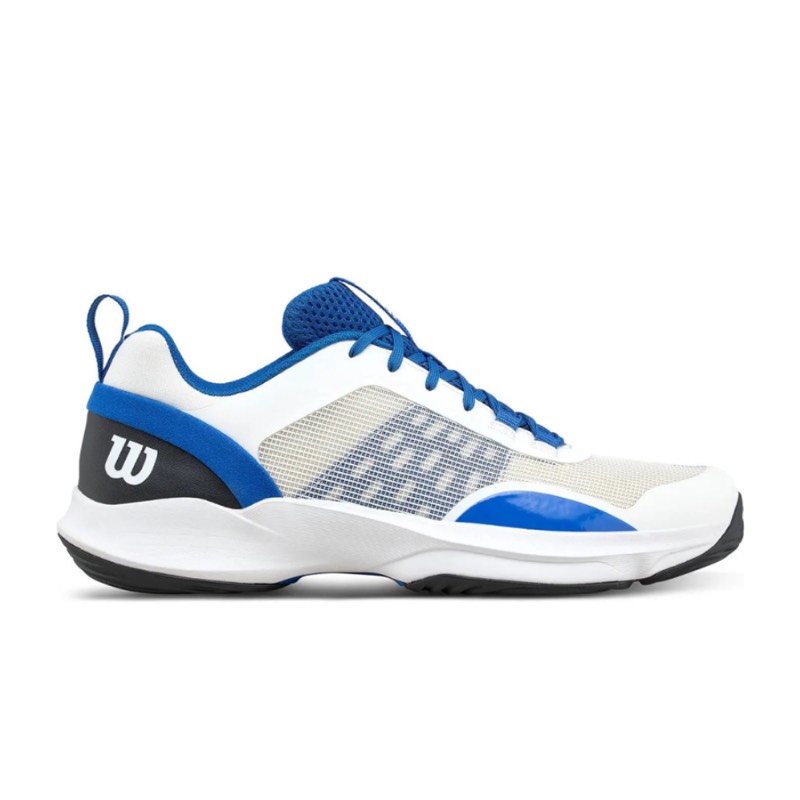
Wilson Hurakn Pro V2
The pick once you've moved past trying padel and now play every week. Wilson builds the Hurakn Pro V2 around a full inner sock that closes around the foot rather than being cinched onto it — the biggest felt difference coming from a laced-down tennis shoe.
The 9mm heel-to-toe drop is the detail worth flagging for tennis converts: low enough to keep you connected to the court at the net, with enough foam under the heel for constant backward resets. At 338g it sits between Wilson's featherweight Hurakn Lite and a full stability shoe, and it's stocked at both Racket Central and Padel USA at the same price.
Weight: 338 g / 11.9 oz | Outsole: Duralast, Optimum Grip | Drop: 9mm | Surface: All-court / padel
Check Your Club First
Footwear policy is the one variable this article can't settle for you — it's set club by club. Find your nearest courts and the club's own contact details in the Padel Browser club directory, then check availability and book.
Frequently Asked Questions
Continue Reading
Best Diamond Padel Rackets 2026: Power & Attack Picks
Best Diamond Padel Rackets 2026: Power & Attack Picks
Diamond rackets put the balance point in the upper third of the head, which buys you leverage on overheads and costs you sweet spot everywhere else. Here are five diamond frames actually in stock at US retailers in 2026, with verified specs and prices - and a straight answer on whether you should buy one at all.
Best Round Padel Rackets 2026: Control & Forgiveness
Best Round Padel Rackets 2026: Control & Forgiveness
Round is the most forgiving shape in padel and the least rewarding on a smash. We checked live US stock at Racket Central and Padel USA, verified every shape against the manufacturer’s own spec sheet, and pulled the published power and control scores for all 41 round frames in the catalog. Here are five worth buying.
When to Buy Padel Gear: Black Friday 2026 Calendar
When to Buy Padel Gear: Black Friday 2026 Calendar
Black Friday 2026 lands on November 27, but it is only one of three moments worth waiting for. We scanned live listings across four US and European storefronts to map when padel rackets, shoes and balls actually get discounted.