
Padel vs Squash: Key Differences Every Player Should Know

Padel vs Squash: Key Differences Every Player Should Know
Two enclosed racket sports, two completely different games
Most American racket clubs built their squash courts in the 1990s and their padel courts last spring. Both are enclosed, both let you use the walls, and both get described as "tennis, but in a box." That is roughly where the resemblance stops.
Squash is a solo endurance test in a room the size of a two-car garage. Padel is a doubles chess match in a glass cage more than three times that size. Here is exactly what separates them — and whether the years you spent on a squash court will help you on a padel one.
Padel vs Squash at a Glance
| Padel | Squash | |
|---|---|---|
| Court size | 20m × 10m (66ft × 33ft) | 9.75m × 6.4m (32ft × 21ft) |
| Enclosure | Glass back walls plus mesh sides, often open to the sky | Four solid walls, fully indoors |
| Players | Doubles (4) | Singles (2) |
| Racket | Solid, perforated, stringless, ~355–375g | Strung, open-throated, ~110–170g |
| Ball | Pressurized, ~6.5cm, like a slow tennis ball | Hollow rubber, 40mm, dot-graded by bounce |
| Serve | Underhand, below the waist, after a bounce | Overhead or side, straight to the front wall |
| Walls | Playable only after the ball bounces on the floor | Playable at any time, on any shot |
| Scoring | Tennis scoring — 15, 30, 40, games, sets | Point-a-rally to 11, best of five |
| Net | Yes, 88cm at the center | No net — a low metal tin on the front wall |
The Courts Are Not Close in Size
A padel court is 20 metres by 10 metres — 200 square metres of playing surface shared by four people. A squash court is 9.75 by 6.4 metres, about 62 square metres, shared by two. Each padel player patrols roughly 50 square metres; each squash player owns 31 and has to reach every inch of it.
That gap explains why the two sports feel so different to play. Squash movement is explosive and lateral, organised entirely around recovering to the "T" after each shot. Padel movement is about holding a line with your partner and moving as a pair — up together, back together. Our padel court dimensions guide breaks down the glass, mesh, and net measurements in full.
The enclosure differs too. A squash court is four solid plaster walls with an out-line painted around the top. A padel court is three-metre glass at the back, mesh along much of the sides, and no ceiling at all on outdoor courts — so wind, sun, and evening light are part of the outdoor padel experience in a way they never are in squash.
The Equipment Gap Is Wider Than It Looks
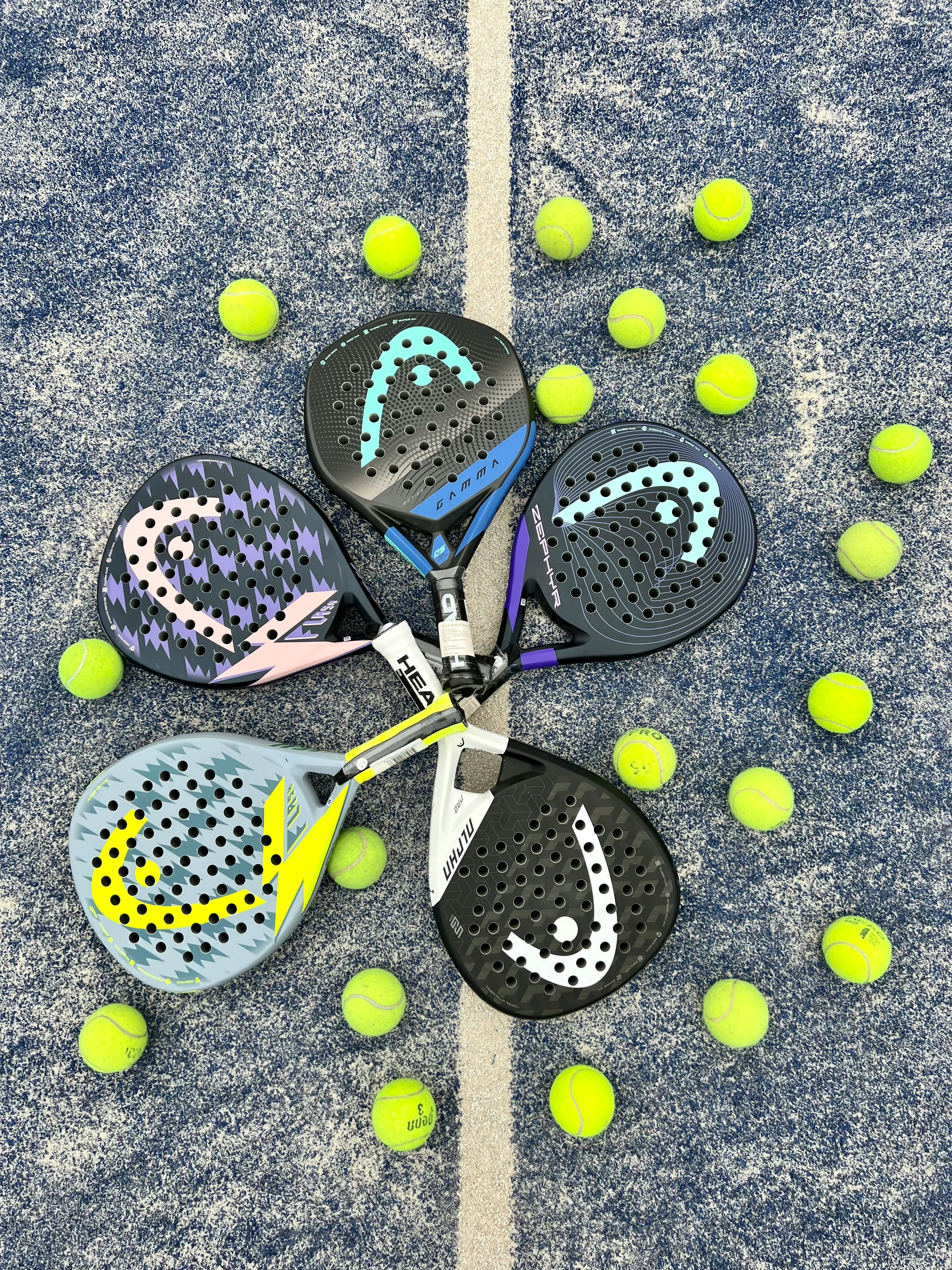
A padel racket has no strings. It is a solid slab — an EVA or FOAM core wrapped in carbon or fiberglass, drilled with holes, capped at 45.5cm long and 38mm thick. Most sit between 355 and 375 grams. Our racket core guide and shapes explainer go deeper on how those choices change the feel.
A squash racket is the opposite animal: strung, open-throated, up to 68.6cm long, and typically 110 to 170 grams. Less than half the weight with half again the reach, which produces the whippy, wrist-led swing that padel actively punishes.
The balls diverge just as much. A squash ball is a 40mm hollow rubber sphere weighing about 24 grams, and it barely bounces until you have warmed it up — the coloured dot tells you how slow it is, with double yellow the slowest and the standard at professional level. A padel ball looks like a tennis ball, measures 6.35–6.77cm, and is pressurized just below tennis spec. It bounces predictably from the first point, cold or warm.
If you are buying a first padel racket, Racket Central carries the widest US inventory, and our beginner racket picks narrow the field further.
How the Walls Work — the Rule That Changes Everything
This is the single biggest difference, and the one squash players get wrong first.
In squash, every shot must eventually reach the front wall, and you can use any wall to get it there. Side wall, back wall, front wall, in any combination. Walls are weapons: boasts, kills, and nicks all exist because you can attack into a wall directly.
In padel, the ball has to bounce on the floor before it touches a wall. Your shot must clear the net and land inside the opponents' court before it can hit their glass. On your own side, the walls are a rescue system — the ball bounces, rebounds off the glass, and you play it back, which is exactly why padel rallies stretch on so long.
So: squash walls are offense, padel walls are defense. A squash player's instinct to smack the ball straight into the side wall is a fault in padel, and it takes a few sessions to unlearn. Our beginner rules guide covers the rest.
Gameplay and Fitness
Squash is one of the most cardiovascularly demanding sports ever measured. Heart rate typically sits at 85–95% of maximum for most of a match, and an hour of competitive play can burn 800–1,000 calories. There is no partner, no doubles rest, and no natural break in the rally.
Padel is intense but pacier. Heart rate spends most of a match in the 140–160 bpm range with spikes past 180 on smashes and scrambles, and an hour burns roughly 300–400 calories recreationally, up to 800 in a competitive match. A 2025 systematic review in Frontiers in Psychology found padel delivers exercise intensity comparable to tennis at lower overuse-injury risk — largely because the short racket and compact swings load the shoulder and elbow less than a full tennis or squash motion.
The social math differs too. Squash needs one other person and rewards you for suffering privately. Padel needs three, and the conversation between points is half the appeal. That is a real part of why padel passed one million American players while squash stayed a club sport.
Which Is Easier to Learn?
Padel, comfortably — on day one.
New padel players rally within minutes. The serve is underhand, the racket face is forgiving, and the walls keep the ball alive when you are out of position. Most people finish a first session having played real points.
A first squash session is mostly chasing a ball that dies on the second bounce. Getting a cold ball to behave takes enough racket speed that beginners spend the opening hour generating pace rather than building rallies.
Long term, both are deep. Padel's ceiling lives in positioning, lobbing, and the overhead family — the bandeja and víbora have no squash equivalent at all. Our common beginner mistakes and doubles strategy guide are the fastest route past the first plateau.
Do Squash Skills Transfer to Padel?
Better than most crossovers. Here is the honest split.
What transfers:
- Reading rebounds. You already know how a ball comes off a wall at speed. This is the skill that takes most padel beginners months, and squash players arrive with it.
- A low, loaded ready position. Squash keeps you bent and balanced; padel wants the same base.
- Compact volleys. The squash volley is already short and punchy, close to what padel asks for at the net.
- Recovery discipline. Returning to the T becomes returning to your half of the net line.
What does not:
- The wrist. Squash's slicing, wrist-led swing sends padel balls into the net or floats them up for a smash. Padel wants a flatter, longer, shoulder-driven stroke.
- Playing alone. Padel positions are paired and side-specific; poaching your partner's ball is an error, not initiative.
- Attacking the walls. As above — the instinct is a fault until you retrain it.
- The overhead game. Nothing in squash prepares you for a bandeja.
Realistically, a club-level squash player looks respectable in one session and is a solid social padel player inside a month. Tennis players convert faster on stroke mechanics; squash players convert faster on wall instincts. Coming from tennis instead? Read tennis to padel.
Where to Try Padel
There are 361 active padel clubs in our directory across the US, with another 30 opening soon — a footprint that did not exist five years ago. Coverage is thickest in Florida, Texas, California, and New York, and courts have now reached 37 states.
Squash gets its own moment in 2028, when it debuts at the Los Angeles Olympics on a temporary court at Universal Studios. You do not have to pick a side — a growing number of American racket clubs run both, and the two sports train genuinely complementary things. Just remember which one lets you hit the wall first.
Frequently Asked Questions
Continue Reading
Padel Nutrition and Hydration: What to Eat and Drink
Padel Nutrition and Hydration: What to Eat and Drink
Padel is longer rallies with half the rest of tennis — and often three hours of social play, not one. Here's how to eat and drink around it: pre-match meals, how much to drink per hour, when you need electrolytes, grazing through an Americano, and what to do about the post-match beer.
The Mental Game of Padel: Focus, Pressure & Partners
The Mental Game of Padel: Focus, Pressure & Partners
In padel you can't have a bad attitude privately — your partner is ten feet away and your mood is one of their playing conditions. Here's what to say after an error, how to handle the golden point and being targeted, and how to stay switched on for a full session.
How to Find a Padel Partner in the US: A 2026 Guide
How to Find a Padel Partner in the US: A 2026 Guide
Padel takes four people, and that is the real reason most Americans quit after one session. This guide covers the five routes that actually work — open play, booking-app matching, WhatsApp groups, clinics and leagues — using booking-platform data from all 361 active US clubs in our directory.