
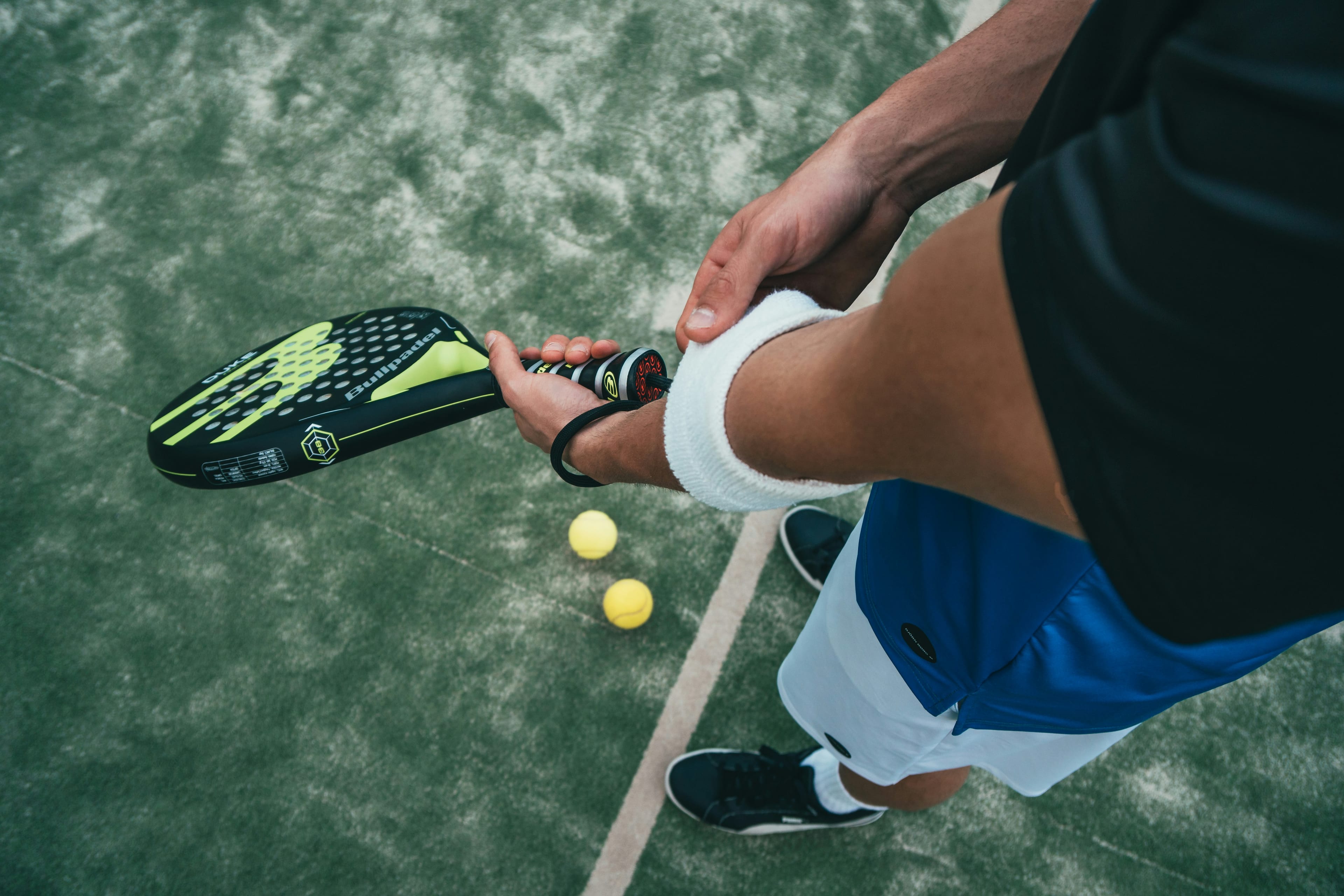
Padel Racket Balance Explained: Low, Medium & High

Padel Racket Balance Explained: Low, Medium & High
Low, medium and high balance, what the millimetre figure really means, and why one brand's head-light is another brand's head-heavy.
Balance changes how a padel racket feels more than any other number on the spec sheet — and it is the number the industry is least consistent about reporting. Two rackets you can buy in the US right now sit about a millimetre apart: HEAD lists the Gravity Pro at "Low (Head Light) · 265 mm," while Bullpadel lists the Hack 04 26 at "≈ 26.4 cm · High (Head Heavy)."
Same measurement, opposite labels. So learn to read the number, not the word. It's the companion to our racket shapes guide and part of our padel racket buyer's guide.
What Balance Actually Measures
Balance is a distance, not a rating. Stand a racket on its butt cap, find the point where its mass splits evenly, and measure up to it from the bottom of the handle. That distance in millimetres is the balance point, and a bigger number means more mass toward the head.
Here is the part nobody explains: those numbers are all higher than your intuition expects. The International Padel Federation caps total racket length at 45.5 cm with a handle no longer than 20 cm, so the geometric middle of a full-length racket sits at just 227.5 mm. Every balance figure published on a racket in US stock today falls between roughly 250 mm and 285 mm — all of it above that midpoint. Every padel racket is head-biased relative to its own frame; the tiers are relative to the padel norm, not to the middle of the racket. A "head-light" padel racket still carries most of its mass above your hand.
Balance also isn't regulated — the FIP rulebook covers length, width, thickness and hole sizes, and never uses the word. It's purely a design choice, which is why brands report it however they like, and mostly don't report a number at all. We pulled the full live catalogue at Racket Central on 10 October 2026: of 145 padel rackets in stock, 127 published some balance spec, but only 25 gave an actual millimetre figure. Wilson and HEAD print millimetres most often; adidas, Nox, Siux, Osaka, Bullpadel and Gamma mostly publish words — and HEAD appears on both lists, so even one brand isn't consistent with itself.
Balance vs Shape vs Weight — Stop Conflating Them
Three separate specs get blended into one vague idea of "feel":
- Weight is how much mass the racket has (usually 345–375 g).
- Balance is where that mass sits.
- Shape is the silhouette, which biases balance without determining it.
Shape and balance correlate, which is why "diamond means head-heavy" feels true. It isn't reliable:
| Racket | Shape | Published balance | Weight | Price |
|---|---|---|---|---|
| Gamma Brooks | Round | High (Head Heavy) | 350 g | $119.99 |
| Bullpadel Flow Women MFinal | Diamond | Low | 350–360 g | $249.95 |
| Head Gravity Pro | Round | Low (Head Light) · 265 mm | 365 g | $179.95 |
| Bullpadel Hack 04 26 | Diamond | ≈ 264 mm · High (Head Heavy) | 365–375 g | $241.15 |
A round Gamma Brooks is head-heavy. A diamond Bullpadel Flow is head-light. And the bottom two rows show the real trap: two rackets about a millimetre apart, labelled at opposite ends of the scale. Shape tells you where the sweet spot sits — our shapes guide covers that properly — not where the mass is.
So ignore the tier word when comparing across brands. Within HEAD's own 2026 line the Gravity Pro at 265 mm is "Low," the Coello Motion at 268 mm is "Mid-High," and the Coello Pro at 272 mm is "High" — seven millimetres spanning that brand's entire vocabulary. We even found the same Osaka Vision Pro Control listed as "Medium (Even)" in one colourway and "250±10 mm / Low (Head Light)" in another. Treat the label as a hint and the millimetre figure as the fact.
Low Balance (Head-Light)
Mass sits back toward the handle, typically 250–260 mm where it's published.
The racket feels quicker than its weight suggests: faster hands at the net, easier volleys and blocks, and real forgiveness when the ball arrives before your preparation does. The cost is leverage — less mass behind the ball, so smashes take more of your own effort to finish.
Who it's for: beginners, defensive and tactical players, anyone on the right side, and anyone managing arm pain. Less mass at the tip means less rotational load on the elbow and shoulder — see our rackets for tennis elbow guide.
In stock now: Wilson Endure V1 2026 (Round, 255 mm, 365 g, $319) is the lowest published figure we found on a current model. Cheaper routes to the same feel: Siux Astra Ctrl 2026 (Round, low, 365 g, $129.99) and Osaka Vision Control (low/head-light, 355–370 g, $150).
Medium Balance
Mass spread evenly, usually 263–268 mm.
This is the default in almost every lineup, and the honest reason is that it works: stable enough that off-centre contact doesn't twist the racket, manoeuvrable enough for net exchanges, and still enough mass up top to put a smash away. Nothing is optimised, so nothing is sacrificed.
Who it's for: most club players, and essentially every "best all-round racket" pick ever written. If you're unsure, or you rotate sides depending on your partner, start here.
In stock now: Wilson Optix V2 Power 2026 (Teardrop, 265 mm, 360 g, $159) and adidas Adipower CTRL 3.3 (Round, "Even (265 mm)", 360–375 g, $149.99) — the same measured balance in two different shapes, which is the point above in one line.
High Balance (Head-Heavy)
Mass forward, from about 270 mm up to 285 mm at the extreme.
More mass further from your hand means more leverage, and leverage is power — overheads, bandejas hit with intent, and the smash all come off harder for the same swing speed. You pay twice: the racket takes more effort to accelerate, and it punishes late preparation, because a head-heavy frame you haven't got round in time is one you can't redirect.
Who it's for: strong, technically sound attacking players with early preparation and reliable footwork — most often on the left side. It's the wrong place to start if you're still learning, and the wrong place to be if your elbow already hurts.
In stock now: Head Extreme Pro 2026 (Diamond, "High (Head Heavy)", 370 g, $299.95), Siux Fenix Pro 2026 (Diamond, high/head-heavy, 365 g, $279.99), and the most head-heavy figure published anywhere we looked — the adidas Adipower Multiweight 3.3 at "Head Heavy (285 mm)" ($189.99).
How to Find Your Racket's Balance (and Change It)
The 60-second pencil test
You don't need the brand to tell you. Lay a pencil or a ruler edge on a table, move the wrist cord aside, and rest the racket across it. Slide the racket until it sits level and stops tipping, mark that point, then measure from the bottom of the butt cap to the mark in millimetres. That's your balance point — the same figure brands print.
Do it with the racket exactly as you play it, overgrip and protector included; the number means most as a before-and-after on the same frame.
Lead tape: where it goes, and what it actually does
Adding weight is legal. FIP Rule 8 permits objects adhered to the racket where they are "specifically used to limit or prevent deterioration, vibration and to distribute the weight," adding that they "must be reasonable in size and positioning."
Now the arithmetic, which is where most advice goes quiet. On a 365 g racket balanced at 265 mm:
- 2 g at 12 o'clock (the tip) moves balance up about 1 mm.
- 2 g split at 3 and 9 o'clock (the sides, mid-head) moves it up about 0.35 mm — but adds noticeably more twist resistance, which is usually the real reason to tape there.
- To cross HEAD's own seven-millimetre gap from "Low" to "High" you'd need roughly 16 g at the tip, taking a 365 g racket to 381 g.
So be realistic: lead tape fine-tunes a racket, it doesn't reclassify one. You'll reach a weight you can't swing long before you turn a control frame into a power frame. If you want meaningfully more head mass, buy the head-heavy racket.
Tennis Express stocks the usual options: Tourna Unique Lead Tape ($9.95, ¼ inch wide, 4 inches = 1 g) and Gamma Lead Tape ($7.99, ½ inch wide, 2 inches = 1 g). Both carry a California lead warning — wear gloves and wash your hands. Several brands build the adjustment in instead: adidas's Weight & Balance System offers up to 11.2 g of repositionable weight across the Metalbone and Adipower Multiweight lines, and Bullpadel sells a Custom Weight accessory ($24.99) for compatible frames.
How an overgrip shifts balance toward the handle
This is the cheapest lever, and it works in the direction most club players actually want.
An overgrip weighs about 5 g — HEAD publishes 5 g and 0.6 mm for its Prime Tour — and all of it goes on the handle, well below the balance point. On the same 365 g / 265 mm racket, one overgrip drops balance about 2.2 mm and two drop it about 4.4 mm.
Read that against the tape figures above: a single overgrip moves balance more than twice as far as 2 g of lead at the tip, in the opposite direction, for about two dollars. If a racket feels sluggish and arrives late, add a wrap before you buy anything — our best padel overgrips guide covers which to pick. For a bigger handle-ward shift, Babolat's Balancer Tape ($13.99) is tungsten rather than lead, in 3 g strips made to wrap around the grip — roughly 1.4 mm each.
Matching Balance to Your Side of the Court
Side of court is the most useful filter here, because the two roles ask opposite things of a racket.
The right side organises: more volleys, blocks and resets, more balls taken early and redirected. That job rewards a racket you can get round quickly, so lean low to medium. The left side finishes points — overheads and smashes, which means leverage — so lean medium to high.
Two caveats. This is a tiebreaker, not a starting point: below solid intermediate, take the medium-balance racket for whichever side you play and revisit it when your preparation is consistently early. And if your elbow or shoulder is complaining, balance beats loyalty to your side — go head-light regardless and accept the lost smash power.
Not sure which side suits you? Start with left side vs right side in padel, then see our best padel rackets by court side. Once balance is settled, the remaining feel decisions are core and face: EVA vs FOAM cores and 3K vs 12K vs 18K carbon.
Frequently Asked Questions
Continue Reading
Best Padel Ankle Brace & Knee Supports 2026: US Picks
Best Padel Ankle Brace & Knee Supports 2026: US Picks
The ankle and foot is the most commonly injured region in padel, ahead of the elbow — yet almost every padel brace guide that ranks is a UK or EU storefront. Here are six ankle and knee supports you can buy from US retailers in 2026, what each category actually does, and why a bulky brace can cost you half a shoe size.
Padel Gear You Can't Buy in the US (and What to Buy)
Padel Gear You Can't Buy in the US (and What to Buy)
US padel gear guides are mostly written for European buyers, so they recommend shoes and frame protectors you simply can't buy here. We pulled the live product feeds of four US storefronts to see what is genuinely missing in 2026 — and found the gap has closed in two places nobody has written about yet.
Padel Clothing Brands 2026: What US Retailers Stock
Padel Clothing Brands 2026: What US Retailers Stock
We went through every padel garment in stock at the three US retailers that genuinely carry apparel — about 500 items — and priced them in dollars. Tennis kit covers most of it, Bullpadel and Drop Shot are the brands worth importing, and Nox, StarVie and Joma clothing simply is not sold here.