
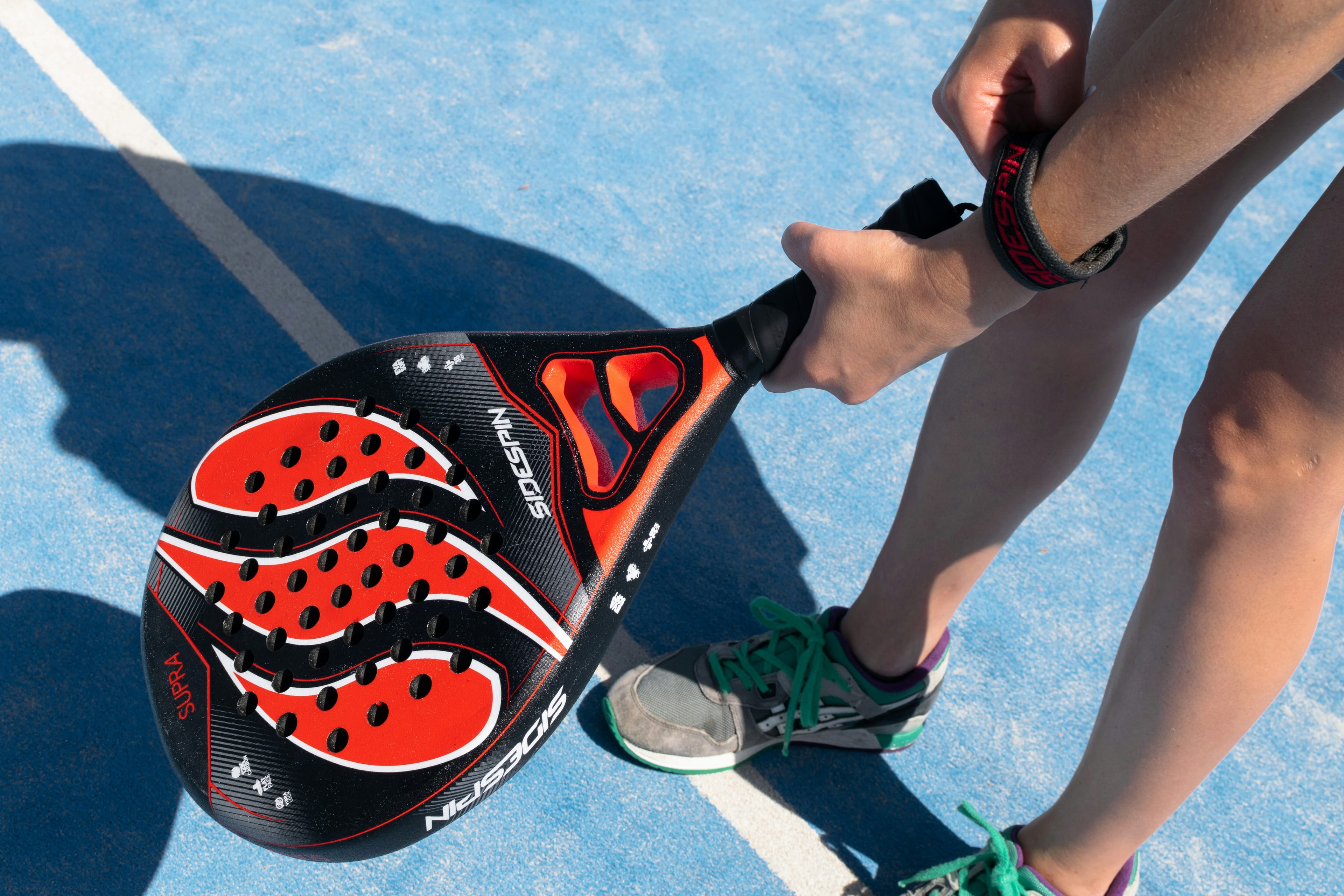
Left Side vs Right Side in Padel: Which Side to Play

Left Side vs Right Side in Padel: Which Side to Play
The builder, the finisher, and how to work out which one you are
Every padel pair splits the court down the middle, but the two halves are not the same job. The right side — the deuce or odd court — is the builder. The left side — the ad court — is the finisher. That is the textbook. In practice the line has blurred, and the side that suits you has far more to do with what you actually do well than with a label.
The two roles, in one paragraph
The right side controls; the left side closes. The right-side player wins by making the rally uncomfortable for long enough that an opening appears. The left-side player wins by taking it. Everything below answers one question: which of those sounds more like you, and which more like your partner?
The right side (deuce/odd court) — the builder
What the right-side player is responsible for
For a right-hander on the right, the geometry is simple: your forehand points at the side wall, your backhand covers the middle. That shapes the job. You take most first balls after the serve, keep the ball deep and awkward, and hold the rally together until your partner gets a chance to attack.
adidas coach Alberto Pulido, interviewed by All For Padel, describes the right-side player as "the brain", the player with control, whose skills should include "playing with different speeds and angles".
Sensa Padel — Tennessee's first padel club, six outdoor courts in Nashville's Germantown — puts it more plainly: the right-sider is the court's DJ, blocking at the net and constantly talking. That talking half of the role is underrated; pair it with our guide to padel hand signals.
Why beginners should start here
Because the right side asks for fewer high-risk shots. You are rarely required to hit a winner — you are required to keep the ball deep, cross-court, and in play, a skill you can build in a month. The left side asks you to attack a ball above your head, under pressure, with your partner's court behind you. That takes far longer.
Starting right lets you learn padel's actual rhythm — defend, lob, recover, advance — without needing a finished smash. If you are new to the pair game, read this alongside our beginner's guide to padel doubles strategy.
The backhand-down-the-line and the cross-court exchange
Your bread and butter is the cross-court exchange with the opposing right-side player: diagonal, forehand to forehand, the longest and safest line on the court. Win it and your pair controls the point by default.
The shot that breaks the pattern is the backhand down the line — a low, flat ball at the opposing left-side player's feet as they move forward. It is almost never a winner, and it is not meant to be. It exists to stop the other team taking the net for free. Our complete guide to padel shots has the mechanics.
The left side (ad court) — the finisher
Covering the middle with your forehand
Here is the terminology that confuses nearly everyone. The left side is commonly called the "backhand side" and the right the "drive" or "forehand side" — but that naming describes only your own corner. For a right-hander on the left, balls into your corner off the side glass are backhands; balls down the middle are forehands. Both are true at once, and it is the second one that decides your role.
Because the middle belongs to your forehand, you own the seam. Pulido describes this as the player who keeps "his strong hand in the centre of the court", which leads them to "sometimes occupy a small percentage on the side of his partner". You are not staying in your lane — you are crossing into your partner's, on purpose.
Why the left side takes most of the smashes
This is the most-repeated claim about court sides, and it needs a caveat.
It is true in the narrow sense. A lob down the middle is the left-side player's ball, taken on the forehand. Sensa Padel describe the split exactly that way: when a lob comes down the middle, the left-side player plays it on the forehand while the right-side player calls out what the opponents are doing.
It is shakier in the broad sense that the left side simply gets bombarded more. The largest published analysis of lobbing in the pro game — Villar-León and colleagues in Applied Sciences (2024), who coded 2,063 lobs across ten matches of the 2024 Premier Padel season — found no association between a player's side and how often they lobbed (p = 0.796). Lobs came roughly 50/50 from both members of a pair. What the researchers did find was directional: right-side players hit more cross-court lobs, left-side players hit more lobs down the middle, and in the men's game the down-the-middle lobs were the ones that tended to get over the opposing pair.
That study measured who hits lobs, not who attacks them. So treat "the left side takes most of the overheads" as a claim about geometry — the middle ball is yours — rather than a measured fact about volume. Either way, the left side needs a dependable bandeja long before it needs a spectacular smash.
The volume of court you actually have to cover
Your half, plus the seam, plus the trips into your partner's half when you poach. That is more ground than the right side covers, which is why left-side players tend to be the more mobile half of a pair — and why "who finishes better?" and "who moves better?" usually have the same answer. Our court coverage guide has the movement patterns.
Left-handers: why you almost always belong on the right
If you are left-handed, the standard advice is to play the right side, and unlike most padel lore this one is close to unanimous.
Put a lefty on the right and a righty on the left, and both forehands meet in the middle. Padel Magazine calls this the perfect combination: both players cover the center with the forehand, leaving the backhands for balls near the glass, which also puts both smashes in the middle. Pulido makes the same point — such a pair can "cover the centre of the court from both sides", and statistically more shots are played through the centre.
"Almost always" is doing some work, though. If two left-handers pair up, one plays left and everything mirrors. And the rule settles handedness, not hierarchy — a left-hander on the right inherits the middle-covering forehand too, which is why in left-right pairs the neat builder/finisher split gets genuinely blurry.
Mixed pairs and the honest version of that conversation
The default at a lot of clubs is that the man plays left. Sometimes that is correct. Often it is a habit nobody examined.
The left side needs whoever can hit an overhead under pressure and take responsibility for ending points. The right side needs whoever can absorb pace, hit a reliable cross-court, and read a rally two shots ahead. Neither is a gendered skill. If the better overhead and the better movement belong to the woman in the pair, she should be on the left, and the pair will win more matches.
The useful version of this conversation is the specific one. Who has the more reliable smash right now? Who panics less with the ball above their head? Have it before the match, not during it — our mental game guide covers why mid-match arguments about sides are usually about something else.
How to choose as a pair — a short decision framework
Run these in order and stop at the first clear answer.
- Is exactly one of you left-handed? That player goes right. Done.
- Who has the more reliable overhead? Not the biggest — the more reliable. That player goes left.
- Who moves better laterally and is happier poaching? Left.
- Who is calmer on the first ball after the serve? Right.
- Still tied? Play a set each way and count unforced errors, not winners.
Pulido's own tiebreaker: test both sides and you will find one where "we feel more comfortable, we miss fewer balls and we read the game better".
Should you specialise, or learn both?
Both, then one — in that order.
Padel USA notes that professionals tend to have a preferred side and stick to it, while beginners should play both sides when starting out. Below a solid intermediate level, specialising early mostly hides a hole in your game — and it makes you useless to three quarters of the people who might invite you to play.
Pulido agrees, recommending "not being too selective about what side to play on". He also argues the roles have converged: "we can see that there isn't such a marked difference between players on each side of the court".
The pros are a useful check on stereotypes. Agustín Tapia — a right-hander — plays the backhand side alongside Arturo Coello, a forehand-side player; together they are the world's number one Premier Padel pair. Sanyo Gutiérrez, one of the great touch players in the sport, plays the right. There is no physical archetype for either side, only a job description.
Drills to get comfortable on your side
Fifteen minutes each, and none of them need a coach.
Right side — the cross-court metronome. Two players rally cross-court from the right-side corners, no winners allowed. Target: 30 consecutive balls past the service line. This trains the one shot that decides most club points.
Left side — the middle lob feed. Have a partner feed lobs down the middle from the far side. Take every one on the forehand, moving back and across. Hit bandejas for the first 20 before you are allowed a single smash. The goal is that the middle ball stops feeling like a decision.
Both — the switch set. Play a full set on your non-preferred side against opponents a touch weaker than you. Once a month keeps the option alive.
If the honest conclusion is that you and your regular partner are both finishers, that is not a positioning problem — it is a roster problem. Our guide on how to find a padel partner is the next read, and if you are shopping for a frame to match your side, we break that down in best padel rackets by court side.
Frequently Asked Questions
Continue Reading
Padel Cooldown & Recovery: The 10-Minute Post-Match Routine
Padel Cooldown & Recovery: The 10-Minute Post-Match Routine
Padel's most common injuries are tendinopathies in the Achilles and elbow — the kind that build quietly over months. This is the ten-minute post-match routine that manages them: five stretches, foam roll work, and the refuel window that matters.
Padel Nutrition and Hydration: What to Eat and Drink
Padel Nutrition and Hydration: What to Eat and Drink
Padel is longer rallies with half the rest of tennis — and often three hours of social play, not one. Here's how to eat and drink around it: pre-match meals, how much to drink per hour, when you need electrolytes, grazing through an Americano, and what to do about the post-match beer.
The Mental Game of Padel: Focus, Pressure & Partners
The Mental Game of Padel: Focus, Pressure & Partners
In padel you can't have a bad attitude privately — your partner is ten feet away and your mood is one of their playing conditions. Here's what to say after an error, how to handle the golden point and being targeted, and how to stay switched on for a full session.