
Can You Play Padel in the Rain? Wet Court Safety Rules

Can You Play Padel in the Rain? Wet Court Safety Rules
What rain does to the turf, the ball and the glass — the three stop rules, and where the indoor courts actually are.
Heat you plan around. Cold you dress for. Rain arrives in the middle of the third game and leaves four people standing on a wet court arguing about whether to finish the set.
Here is the call, and where your indoor backup actually is — because for most American players that is the part that decides the evening. (Third in our weather series, alongside playing padel in the heat and playing padel in cold weather.)
The Short Answer
A light drizzle on a well-drained court, with everyone shortening their steps and hitting flat: fine, if you accept a worse game. Anything past that — standing water, a sheen on the turf, thunder within earshot — is a stop.
The risk in wet padel is not that you play badly. It is that padel footwork is built on controlled slides and hard changes of direction, and a wet court is where that footwork ends against a pane of glass.
What Rain Actually Does
Traction goes first, and it is the only part that can hurt you
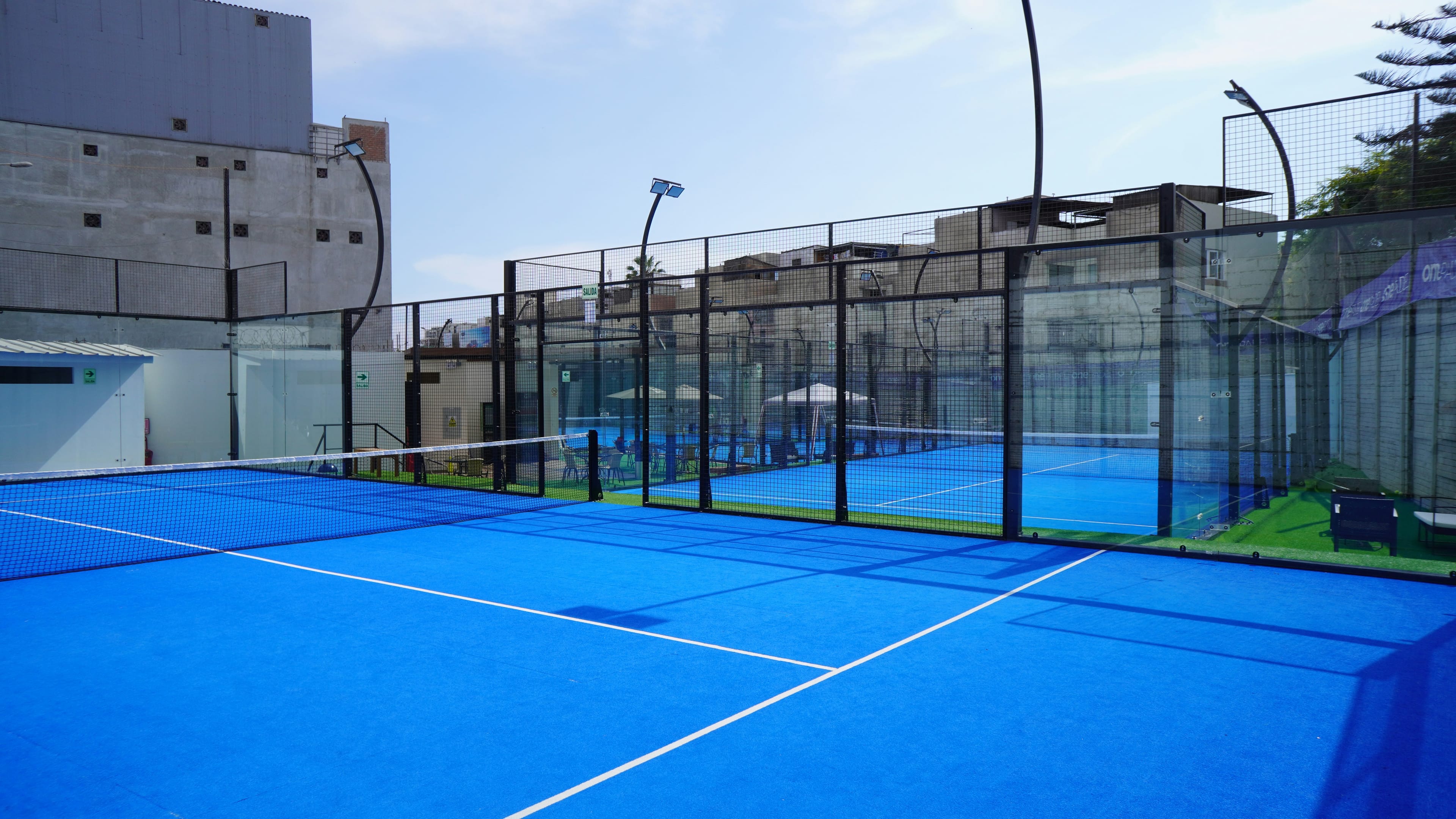
A padel court is artificial turf with silica sand brushed down into the fibres, and that sand is what lets you slide and stop on command. Add water and a film sits on top of the fibres while the sand underneath compacts, so the slide you normally control becomes one you cannot. See padel court surfaces explained for how the layers work.
The ball gets heavy and the bounce dies
Felt absorbs water. A soaked ball is heavier, leaves the strings slower and drops shorter — the exact opposite of what a hot afternoon does to it. It never fully recovers either, which is why a rained-on tube is a spent tube (ball buying guide).
Wet glass kills the rebound
Padel defence is built on the back wall: let it pass, take it off the glass, lob, reset. Water deadens that rebound — the ball skids off low and short, dying at your feet instead of sitting up. That removes about half your defensive options.
Your grip goes slick and the light goes early
A saturated overgrip lets the handle rotate on contact, which is how you shank a bandeja into the ceiling. And rain comes with cloud, so outdoor courts lose usable light well before sunset.
The Stop Rules
Puddles or pooling — stop
If water is standing anywhere in the playing area, the court's drainage is already overwhelmed and the rest of the surface is saturated too. This is not a "play the dry end" situation.
An unplanned slide — stop
The split-step is the tell. Plant and pivot at the net once, deliberately. If your foot goes somewhere you did not send it, the session is over — the ankle and knee injuries in our common padel injuries guide are overwhelmingly a traction story.
Thunder — stop, and it is not a judgment call
The National Weather Service rule is one line: when thunder roars, go indoors, and stay there until 30 minutes after the last clap. Not 30 minutes after the rain stops — after the last thunder.
An outdoor padel court is a poor place to test this. You are on open ground, ringed by metal fence posts, often the tallest thing in the lot. The NWS is also explicit that open-sided structures are not shelter, so a covered court with open walls does not count. A building or a hard-topped vehicle does.
If You Do Play Through Light Rain
- Shorten your steps. No slides, no lunges, no sharp direction changes.
- Flatten everything out. Spin needs the strings to bite; a wet face slips instead. Hit through the ball and aim down the middle.
- Stop waiting for the wall. Take the ball earlier, before the glass kills it.
- Rotate in dry balls. Keep the spare tube in a closed bag and swap every few games.
- Hang a towel on the net post. Drying your hand and grip between points is the cheapest safety equipment in the sport, and a fresh overgrip from Racket Central costs less than a physio appointment.
- Check your soles. A worn outsole that was fine on dry turf is a liability on wet turf (best padel shoes by court surface).
Where Your Indoor Backup Is
Of the 392 active clubs we track, 174 are outdoor-only, 141 are fully indoor and 37 run both. Rain does not stop padel nationally. Whether it stops your padel is entirely a local question, and the answer is not the one most people expect.
Florida and the Gulf Coast
Florida is our largest market at 93 clubs, 45 of them outdoor-only against 31 fully indoor. It is also the country's lightning capital, and the summer pattern is dependable: convection builds through the afternoon, dumps for half an hour, clears.
South Florida has the deepest indoor inventory in the country to absorb it. Urban Padel in Doral and Xcel Padel West Palm run 12 indoor courts each, Replay Club in Boynton Beach has 10, and The Gables Padel in Miami and Padel X Boca Raton have eight apiece. In Orlando, Lake Padel Orlando and Padel Plus Indoor Racquet Club cover the storm hours. Texas is thinner: 30 outdoor-only clubs against 15 indoor.
The Pacific Northwest
This is the uncomfortable one. The two rainiest big metros in the country have the thinnest indoor inventory of anywhere we cover.
Oregon has two clubs on file, and Foundry Padel in Portland — four courts, indoors — is the only one open. Washington also has two: Pacific Padel Project in Bellevue, which is outdoor, and Cascadia Padel in Kirkland, which is indoor and not open yet. The Seattle metro currently has no open indoor padel court at all.
The Northeast and Midwest
New York splits almost evenly, 11 indoor against 12 outdoor, but the indoor courts sit in the city: Padel Haus Williamsburg, SPORTIME Randall's Island, Kith Ivy and Reserve Upper East Side. The Hamptons cluster is nearly all outdoor, so one October nor'easter empties the East End.
Massachusetts has three indoor clubs among seven: PADELHUB Boston, Padel Boston in Dedham and Bosse Sports. Illinois is the outlier in the other direction — eight of nine clubs are indoor, including Union Padel Club and Proximo Padel — so Chicago weather barely touches Chicago padel.
Filter by indoor on our club directory before you commit to a booking, and see indoor vs outdoor padel for how the two play differently.
After the Rain
A modern outdoor padel court sits on a permeable base with the turf laid so water drains through rather than pooling, which is why a well-maintained court can be back in play 15 to 30 minutes after light rain stops. An older court, or one whose sand infill has compacted or thinned, holds water for hours — a maintenance story we cover in our court maintenance guide.
Do not go by the clock. Press a towel into the turf near the service line. If it comes up wet, or your shoe skids when you plant and turn, the court is not ready.
For your gear: pull the insoles and dry your shoes at room temperature, never on a radiator or in a dryer — direct heat warps the midsole and unglues the outsole. Towel the racket dry, paying attention to the frame edge, because water working under a chipped bumper into the carbon is how frames delaminate. Strip a soaked overgrip rather than letting it dry on the handle. Write off the balls.
The Short Version
Drizzle on a draining court: shorten your steps, flatten your shots, forget the back wall, and accept a worse match than you wanted. Standing water, a slide you did not ask for, or thunder in the distance: stop, without debate.
And if you play somewhere it rains for a living, work out where your indoor backup is before the sky opens — not while you are standing in it.
Frequently Asked Questions
Continue Reading
Golden Point vs Advantage: Padel's 40-40 Rule Explained
Golden Point vs Advantage: Padel's 40-40 Rule Explained
Padel has three ways to settle a game at 40-40, not two: advantage, golden point, and the Star Point that the FIP made the professional standard for 2026. Here is how each one works, who uses it, and how the deciding point changes the way you should play it.
Padel Serve Rules: 7 Illegal Serves Players Get Wrong
Padel Serve Rules: 7 Illegal Serves Players Get Wrong
Most padel serve arguments end without anyone opening the rulebook. We opened it — here are the seven illegal serves club players make every week, each one quoted from the FIP Rules of Padel. Including the widely repeated 1.06 m contact height that doesn't appear in the rulebook at all.
Padel Court Surfaces Explained: Turf, Sand & Speed
Padel Court Surfaces Explained: Turf, Sand & Speed
Every padel court in the US is artificial grass over concrete, dressed with silica sand - but turf type, pile height and how much sand is left decide how fast the ball comes at you. Here is how to read the court under your feet in the first two minutes of a warm-up, and adjust before it costs you a set.