
Best Round Padel Rackets 2026: Control & Forgiveness

Best Round Padel Rackets 2026: Control & Forgiveness
Five US-available picks, verified against manufacturer specs — plus the finishing power round frames actually cost you
Round is the shape everyone recommends and almost nobody writes about honestly. It is the most forgiving mold in padel, and it is the least rewarding one when you climb to the net and swing at a ball you should be putting away. Both things are true at once, and which one matters more depends entirely on how you win points.
This is a shape guide, not a playing-style guide. If you already know you want control regardless of geometry, our control-player picks span every mold. If you want the primer on how the three shapes differ, start with padel racket shapes explained. What follows is specifically about the round mold — what it does, what it costs you, and which round frames you can actually buy in the US right now. Stock and prices below were checked at Racket Central and Padel USA on September 16, 2026.
What Makes a Racket "Round" Shaped
Padel's rules cap a racket at 45.5 cm long, 26 cm wide and 38 mm thick. Every mold is a different answer to how you fill that rectangle.
A round frame pushes its widest point to the middle of the face and keeps mass low, toward the handle. Three things follow from that:
- The sweet spot sits dead center, where your contact naturally lands, instead of high on the face where you have to reach for it.
- The effective hitting area is as large as the rules allow. Adidas publishes 485 cm² for the round Metalbone Ctrl; Head publishes 498 cm² (77 in²) for the Gravity Pro. Off-center contact still produces a playable ball.
- Swing weight is low. The head-light balance means the racket changes direction fast, which is why round frames feel quicker at the net than their static weight suggests.
One warning before you shop: do not trust a store's shape filter. Padel USA files the Nox AT10 Pro Cup Hard under "Round Shaped Rackets," while the spec block on that same product page reads "Shape: Drop / Teardrop." Shape categories are merchandising; the manufacturer's spec sheet is the record. Every frame below was confirmed against the manufacturer's own description, not a collection page.
Who Round Rackets Are For
Beginners and improvers. A larger, centered sweet spot turns mishits into rallies, and that feedback loop is worth more in your first two years than any material upgrade. Our beginner racket guide goes deeper on the first purchase.
Defenders and back-court players. If you build points with lobs, blocks and resets rather than finishing them with a smash, the round mold rewards exactly the shots you hit most.
Anyone with elbow or shoulder trouble. A frame that does not twist on off-center contact transmits less shock to the joint. See our tennis elbow picks and lightweight guide for the full shortlists.
The Trade-Off Nobody Mentions
Here it is plainly: round frames are the most forgiving shape and the least rewarding on a smash.
The reason is leverage. A centered sweet spot gives you the shortest lever arm between hand and contact point. That is what makes the racket easy to swing and stable on mishits, and it is the same property that caps how much head speed you convert into ball speed on an overhead. You do not lose the ability to finish; you lose the free power a diamond hands you when you catch one clean.
For most club players that trade is worth making — they lose more points to errors than they win with winners. But if you are the one ending points from above the net, a round frame will feel like it is holding you back, and it will be.
How We Picked
- In stock in the US on September 16, 2026 at Racket Central or Padel USA, with a real USD price.
- Shape verified in the manufacturer's spec text, not a store category.
- No frames you cannot buy here. Three models that dominate the English-language search results for this term — the StarVie Raptor Plus, the Head Alpha Motion and the Babolat Contact — were cut. Neither US retailer stocks a single StarVie or Head Alpha SKU, and the Contact is a 2024 model currently out of stock. US distribution runs roughly a season behind Europe, and roundups written for UK and EU shoppers do not account for it.
The Picks
Head Gravity Pro
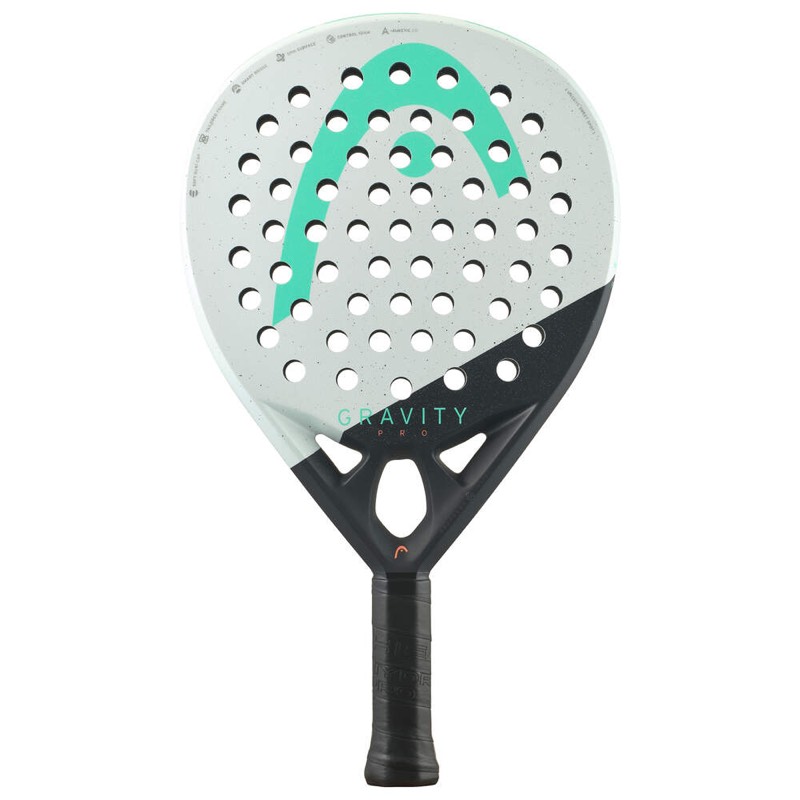
The Gravity Pro is the round frame that gives up the least. Its listing rates it 95 for control and 85 for power, and that 85 is what earns it the top spot. Only three of the 29 scored round frames in Racket Central's catalog match or beat it on power: a $99 Slazenger that gives back five points of control, and two Adidas Cross It models at $265 and $350.
The reason is the hybrid woven face: carbon for stiffness, fiberglass for a softer, more connected strike. Add Control Foam, a 498 cm² head and a 265 mm head-light balance, and you get a racket that swings like a defensive frame but still puts the ball away. Both retailers stock it at the same price.
The caveat: this is still the 2024/25 mold on American shelves. That is normal here, and it is also why it is $199.95 instead of $300.
Weight: 365 g | Shape: Round | Balance: 265 mm (head-light) | Head size: 498 cm² | Level: Advanced
Babolat Counter Origin
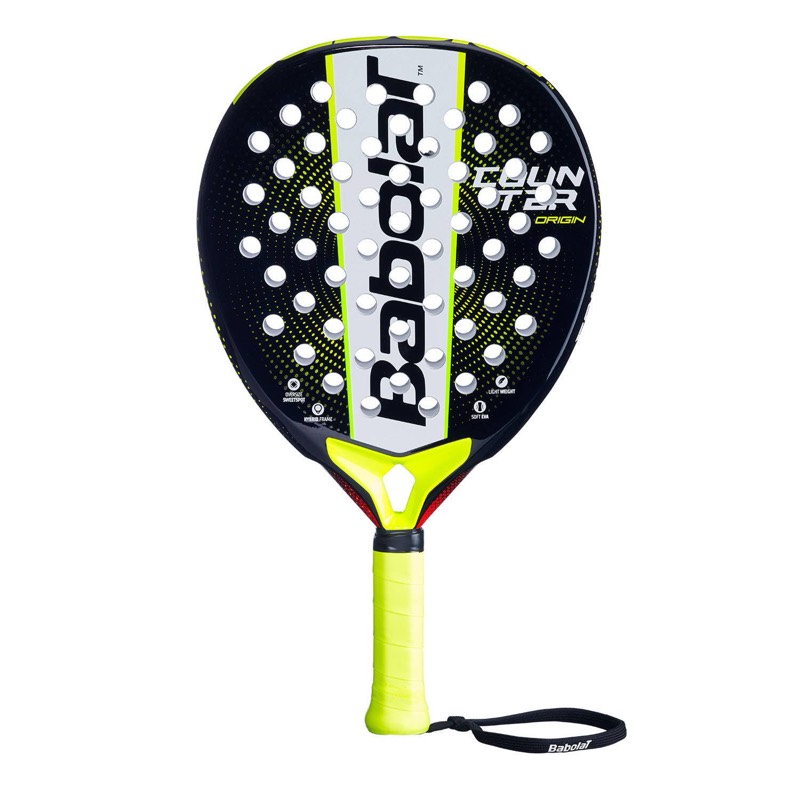
At $84 this is the cheapest genuinely round frame worth owning, and Babolat did not cut the corner that usually gets cut at this price: it is an oversize round format with a fiberglass face and an EVA core, rated 90 for control against 68 for power.
That power number is the honest part: this racket will not hit through anybody. What it will do is keep the ball in play while you learn where the middle of the face is. Buy it, play a season on it, and put the money you saved into coaching — you will improve faster than you would on a $300 frame.
Shape: Round (oversize) | Face: Fiberglass | Core: EVA | Balance: Medium (even) | Level: Beginner
Head One Ultralight
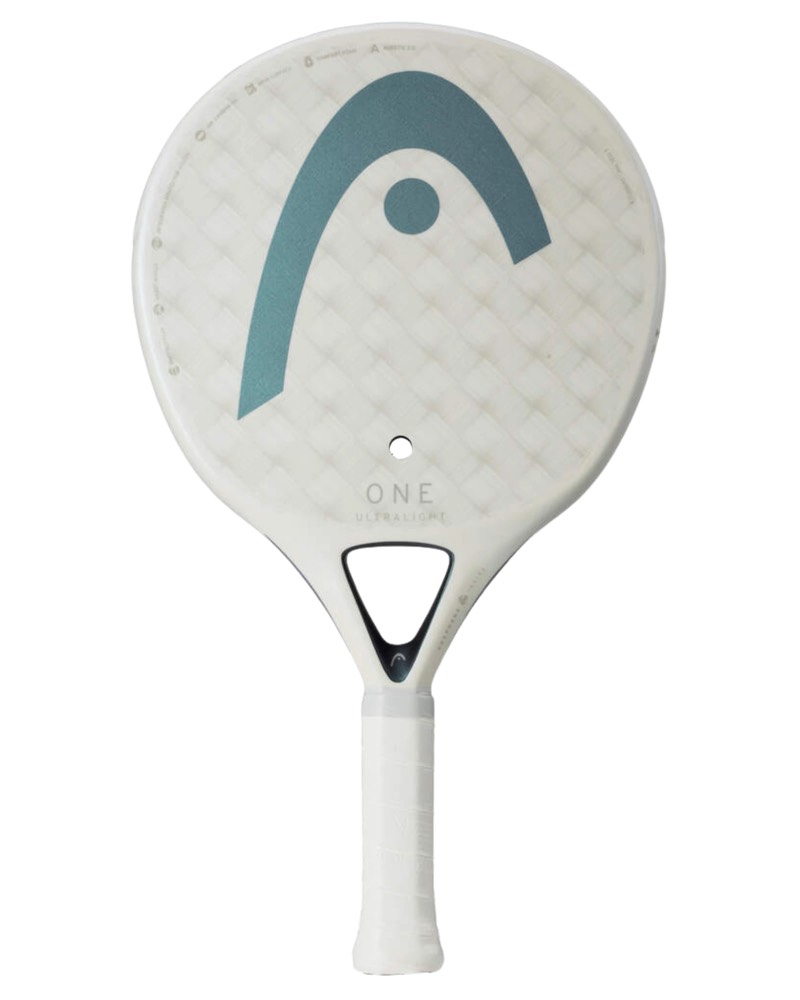
At 300 grams this is the lightest adult padel racket on the market, and it is built on a round mold with a standard head size and an extended grip — which is the combination you want if your elbow is the reason you are shopping. Most rackets ask you to choose between a big sweet spot and a light frame. This one does not.
Head pairs it with Auxetic 2.0 for feel, Comfort Foam to widen the sweet spot and a Soft Butt Cap for vibration damping. The 12K carbon face keeps it from feeling dead despite the weight. Racket Central does not carry it; Padel USA does. If you want the same comfort brief with more mass behind it, the Nox Equation Soft Advanced 2026 ($175 at Racket Central) uses a soft HR3 EVA core in a 355–365 g round frame.
Weight: 300 g | Shape: Round | Face: 12K carbon | Level: Beginner–Intermediate
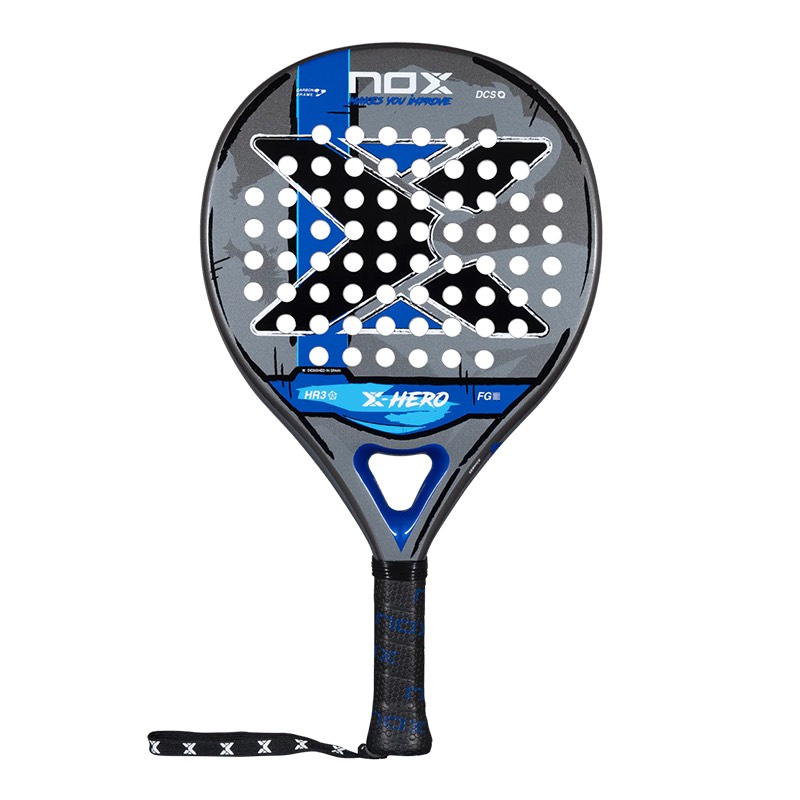
NOX X Hero 2026
$110 for a current-year frame with a carbon perimeter, 3K fiberglass faces and an HR3 White EVA core is the best price-to-spec ratio on this list. Nox rates it 85 control to 70 power, which is a more balanced profile than the Counter Origin — you get a little more ball out of it while keeping the forgiveness.
It is the right pick for the player who has been borrowing club rackets for a few months and is ready to own one, but is not yet sure enough of their style to spend $300. Available in blue and red at the same price.
Weight: 350–360 g | Shape: Round | Face: 3K fiberglass | Core: HR3 White EVA | Level: Beginner–Intermediate
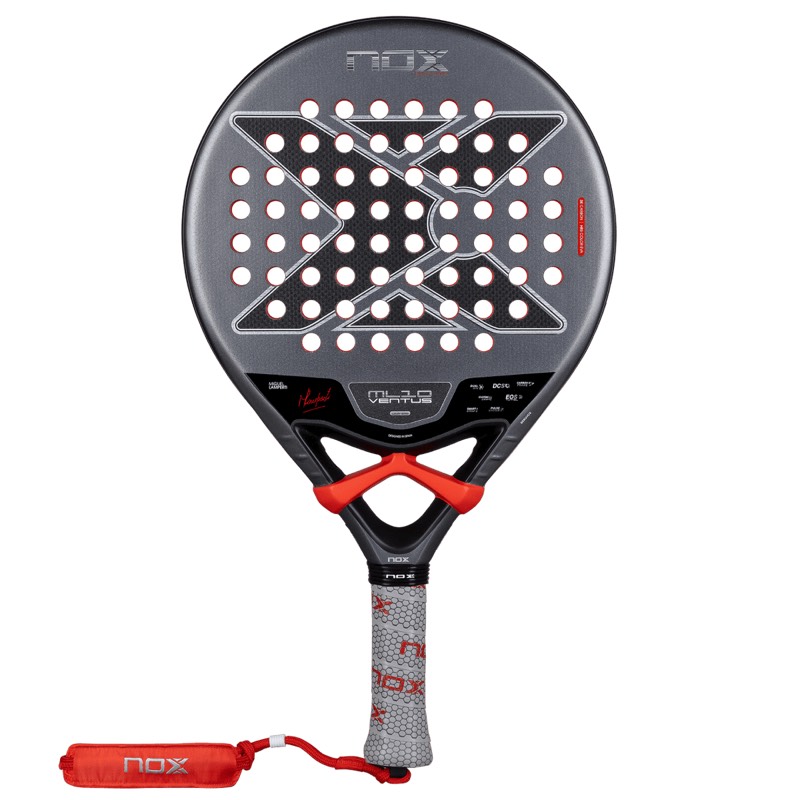
NOX ML10 Ventus Control 3K 2026
The ML10 has carried Miguel Lamperti's initials for years, and the 2026 version is a new mold rather than a refresh. Nox's own spec sheet lists it as round with balanced weight distribution, 3K carbon faces over an HR3 EVA core, 360–375 g, 38 mm — and rates it 93 control to 70 power.
That 23-point gap is the point. This is a frame built to dictate tempo, reset under pressure and hold the net, and it does not pretend otherwise. If you want a round frame with a slightly firmer, more carbon-forward strike, Wilson's Endure Pro V1 2026 ($359 at Racket Central) is the closest alternative at 94 control to 72 power with a 260 mm balance.
Weight: 360–375 g | Shape: Round | Face: 3K carbon | Core: HR3 EVA | Thickness: 38 mm | Level: Professional
Round vs Teardrop vs Diamond: What the Numbers Say
Most shape comparisons are written from feel. We ran the numbers instead. Racket Central publishes a power and control score out of 100 on most of its listings, so we pulled every scored frame in its three shape collections and compared the gap between the two ratings.
| Shape | Frames stocked | With published scores | Median control − power gap | Control rated above power |
|---|---|---|---|---|
| Round | 41 | 29 | +15 | 28 of 29 |
| Teardrop / hybrid | 74 | 57 | 0 | 28 of 57 |
| Diamond | 43 | 30 | −12 | 3 of 30 |
The pattern is about as clean as retail data gets. Round frames are rated for control over power almost without exception — the single holdout across 29 rackets is a $99 Slazenger. Teardrops sit exactly on the line, which is why they are the default recommendation and why there are nearly twice as many of them. Diamonds flip the relationship entirely.
These are retailer scorecards, not lab measurements, so treat the absolute numbers as marketing. The direction, across 116 rackets and eleven brands, is not. If you want the middle of that spectrum, see our teardrop picks.
Should You "Graduate" Out of a Round Racket?
The received wisdom is that round is a beginner shape you outgrow. That is mostly wrong, and it costs people money.
Shape is not a difficulty setting; it describes where a racket rewards you. Plenty of strong club players stay round for their whole careers because the mold matches how they win — from the back, with placement and patience. The ML10 above is a professional-level racket. Nobody is outgrowing it.
The honest test is not your level, it is your limiting factor. Ask what costs you more points right now:
- Errors and mishits? Stay round. A different shape will make that worse.
- Balls you attack but cannot finish? That is the round mold's actual ceiling, and it is the one legitimate reason to move to a teardrop.
- Arm pain? Shape is the wrong lever. Look at weight, core hardness and grip size first.
If you are still working out which of those applies, our racket buying guide walks through the full decision, and you can find somewhere to test the answer in the Padel Browser club directory.
Frequently Asked Questions
Continue Reading
When to Buy Padel Gear: Black Friday 2026 Calendar
When to Buy Padel Gear: Black Friday 2026 Calendar
Black Friday 2026 lands on November 27, but it is only one of three moments worth waiting for. We scanned live listings across four US and European storefronts to map when padel rackets, shoes and balls actually get discounted.
Padel Racket Grip Size Guide 2026: How to Measure and Choose
Padel Racket Grip Size Guide 2026: How to Measure and Choose
US players searching for padel racket grip size get handed tennis charts — the wrong scale entirely. Here is what L1, L2 and L3 actually mean in padel, three ways to measure at home, and what happened when we checked 304 rackets across three retailers for a grip-size option.
Best Padel Racket Protectors 2026: Are They Worth It?
Best Padel Racket Protectors 2026: Are They Worth It?
Padel frames meet glass, fencing and turf as a matter of routine, and a $9 protector is the cheapest insurance you can buy. We checked what US retailers actually stock in September 2026, what a protector really prevents, and the weight-and-balance trade-off nobody else mentions.