
How Much Does It Cost to Build a Padel Court? (2026)

How Much Does It Cost to Build a Padel Court? (2026)
A neutral, US-focused breakdown of padel court construction costs — from glass and turf to site work, indoor builds, and long-term upkeep.
Padel is the fastest-growing racket sport in the country, and one question keeps coming up from club owners, country clubs, and homeowners alike: what does it actually cost to build a court? The honest answer is "it depends" — but the ranges are knowable, and most of the variation comes down to a handful of decisions you make up front.
This is a neutral explainer, not a sales pitch. We don't build courts — we help people find places to play. Use the numbers below to budget and ask sharper questions, then get a firm quote from a professional builder before you commit.
What a Padel Court Actually Costs in 2026
For a single outdoor court in the US, most 2026 estimates land between $25,000 and $60,000, with a typical mid-range build around $35,000–$45,000. Go premium — full-glass panoramic walls, top-tier turf, an indoor enclosure — and the number climbs past $100,000. Strip it back to a bare-bones outdoor court on a site that is already flat and drained, and you can come in closer to $20,000–$25,000.
Why the huge spread? Five things drive it: the court structure itself, the surface and what sits underneath it, site work, lighting and enclosure, and shipping plus installation. A court kit might cost the same whether you build in Florida or Arizona, but the dirt under it — grading, drainage, a difficult slope — can swing the total by tens of thousands. Always treat published prices as ranges, and budget a contingency.
Cost Breakdown
The Court Structure (Standard vs. Panoramic Glass, Steel)
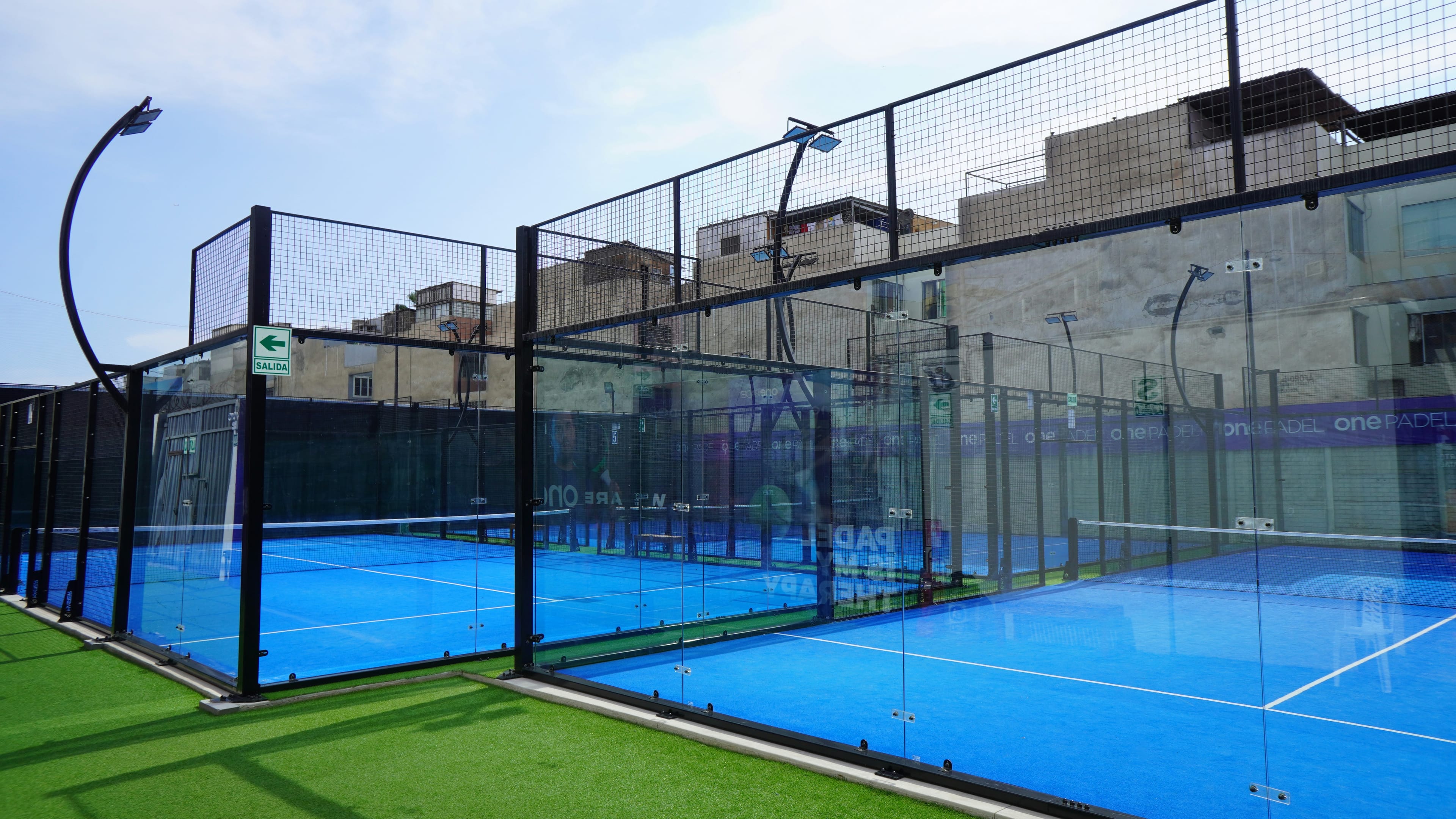
This is the kit you picture when you think "padel court": the galvanized-steel frame, tempered glass walls, and metal mesh. A standard court mixes glass panels with metal mesh in the corners; a panoramic court uses full glass on the back wall (and sometimes the sides) with the supporting posts moved outside the playing area for an unobstructed view. Panoramic looks better and plays cleaner, but the extra tempered glass and heavier structural engineering make it the pricier option. The structure is usually the single largest line item.
Surface & Sub-Base (Asphalt vs. Concrete, Turf)
Padel is played on artificial turf with a sand infill, and the turf alone often accounts for 20–30% of the build. Under the turf you need a hard, level, well-drained base — either asphalt or concrete. Asphalt is cheaper up front (roughly $5,000–$8,000 for the slab) but can crack and shift in climates with big temperature swings. Concrete runs more (roughly $8,000–$12,000) but is more durable and lower-maintenance over a court's 20–25 year life. For the exact playing area you have to fit, see our padel court dimensions guide.
Site Work, Foundation & Drainage
This is the wild card. A flat, stable, already-drained lot needs little prep; a sloped or soft site may need excavation, fill, soil stabilization, and a proper drainage system before anything goes vertical. Site work is exactly why "the same court" ends up costing very different amounts in two different backyards. Get a site assessment early — it is the line item most likely to blow a budget.
Lighting, Fencing & (Optional) Roofing
Outdoor courts need LED lighting for evening play — typically four to eight pole-mounted fixtures — plus perimeter fencing. Roofing or a full indoor enclosure is optional but expensive: a simple roof canopy adds a meaningful chunk, and a full building with walls and climate control is a different category of project entirely (more on that below).
Installation & Shipping
Most court systems are manufactured in Europe and shipped to the US, so freight, customs, and a specialized installation crew all factor in. Once materials are on site, assembly typically takes about 4–8 weeks, depending on the foundation and weather. Permitting can add weeks or months on top of that, so start that conversation early.
Indoor vs. Outdoor: Cost Differences
Outdoor is always cheaper, because you are paying only for the court, base, lighting, and fence. Indoor means all of that plus the building — structural shell, roof, interior lighting design, and ventilation or HVAC. That is why indoor courts commonly run $70,000–$100,000+ per court once the structure is counted. The trade-off is revenue: indoor courts play year-round regardless of weather and command higher booking rates. We break down how the two compare on court in indoor vs outdoor padel.
Standard vs. Panoramic (and Singles) Courts
A regulation padel court is 20m × 10m and built for doubles — that is what nearly every US club installs. Within that footprint, your main cost lever is glass: a panoramic court costs more than a standard mixed glass-and-mesh court because of the additional tempered glass and structural work. A true singles court is narrower (10m × 6m), uses less material, and costs less, but it is rare in the US because doubles is the standard game. And if you build more than one court at once, expect a lower price per court — grading, mobilization, and crews are shared across the whole project.
Ongoing Costs (Maintenance, Resurfacing, Lighting)
A padel court is low-maintenance, not no-maintenance. Routine upkeep means brushing the turf, topping up the sand infill, cleaning the glass, and occasionally replacing nets. The biggest periodic cost is the turf itself: with regular play it wears out in roughly 5–8 years, and resurfacing runs a few thousand dollars per court. Add electricity for the lights and the odd structural check, and a well-built court comfortably lasts 20–25 years.
Is a Padel Court a Good Investment?
For commercial operators, the appeal is straightforward: demand is outrunning supply across much of the country. Efficient clubs aim for six to nine booked hours per court per day, and many cite payback periods in the two-to-four-year range, with indoor courts commanding $50–60 per hour year-round. That math is a big part of why country clubs are adding padel and why new facilities keep opening across the US.
It is not free money — utilization, location, coaching, and memberships make or break the return — but the growth trajectory of padel in the US is real. Run conservative numbers, talk to an operator who has already done it, and treat any single estimate (including ours) as a starting point, not a guarantee. And once the court is built, you still have to equip it — for a home court, Racket Central carries the rackets and balls to get playing.
Frequently Asked Questions
Continue Reading
Padel Cooldown & Recovery: The 10-Minute Post-Match Routine
Padel Cooldown & Recovery: The 10-Minute Post-Match Routine
Padel's most common injuries are tendinopathies in the Achilles and elbow — the kind that build quietly over months. This is the ten-minute post-match routine that manages them: five stretches, foam roll work, and the refuel window that matters.
Left Side vs Right Side in Padel: Which Side to Play
Left Side vs Right Side in Padel: Which Side to Play
The right side builds the point; the left side finishes it. Here is what each role actually demands on court, why left-handers almost always belong on the right, and a five-step framework for settling sides with a new partner — plus what the pro data does and does not support.
Padel Nutrition and Hydration: What to Eat and Drink
Padel Nutrition and Hydration: What to Eat and Drink
Padel is longer rallies with half the rest of tennis — and often three hours of social play, not one. Here's how to eat and drink around it: pre-match meals, how much to drink per hour, when you need electrolytes, grazing through an Americano, and what to do about the post-match beer.